Kapha Dosha in Ayurveda: Qualities, Characteristics, Functions and Types
🌿 Kapha Dosha in Ayurveda: Qualities, Characteristics, Functions and Types
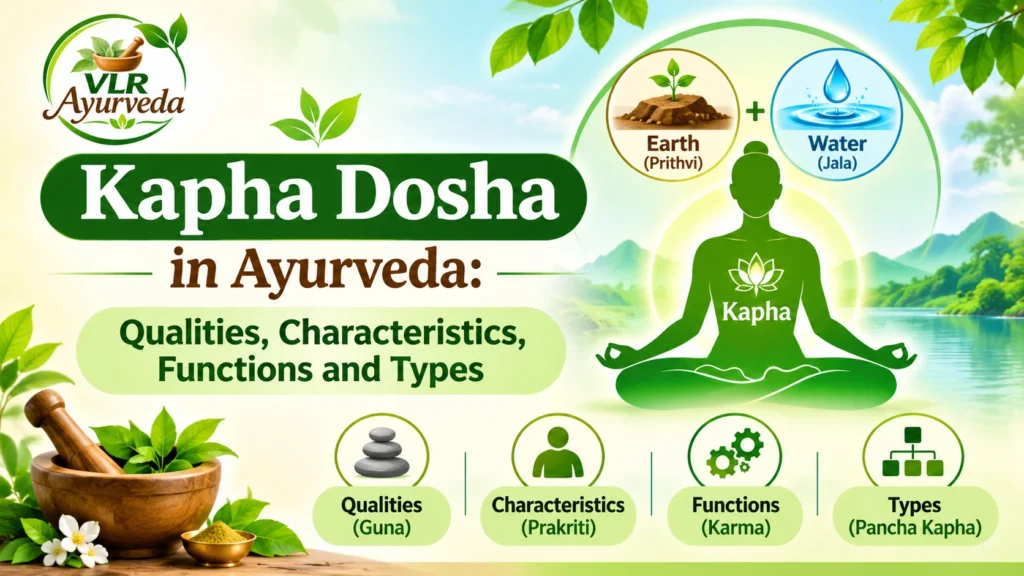
🌿 Introduction to Kapha Dosha
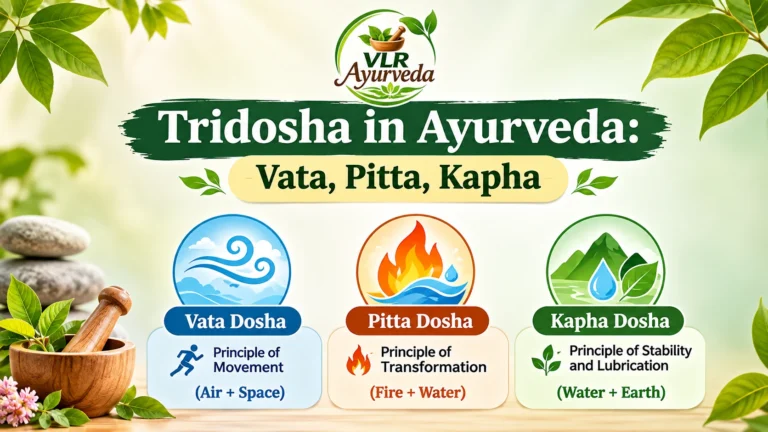
Kapha Dosha is one of the three fundamental biological principles described in Ayurveda, collectively known as Tridosha. The three doshas are Vata, Pitta and Kapha. Each dosha plays an important role in maintaining the structural and functional balance of the human body.
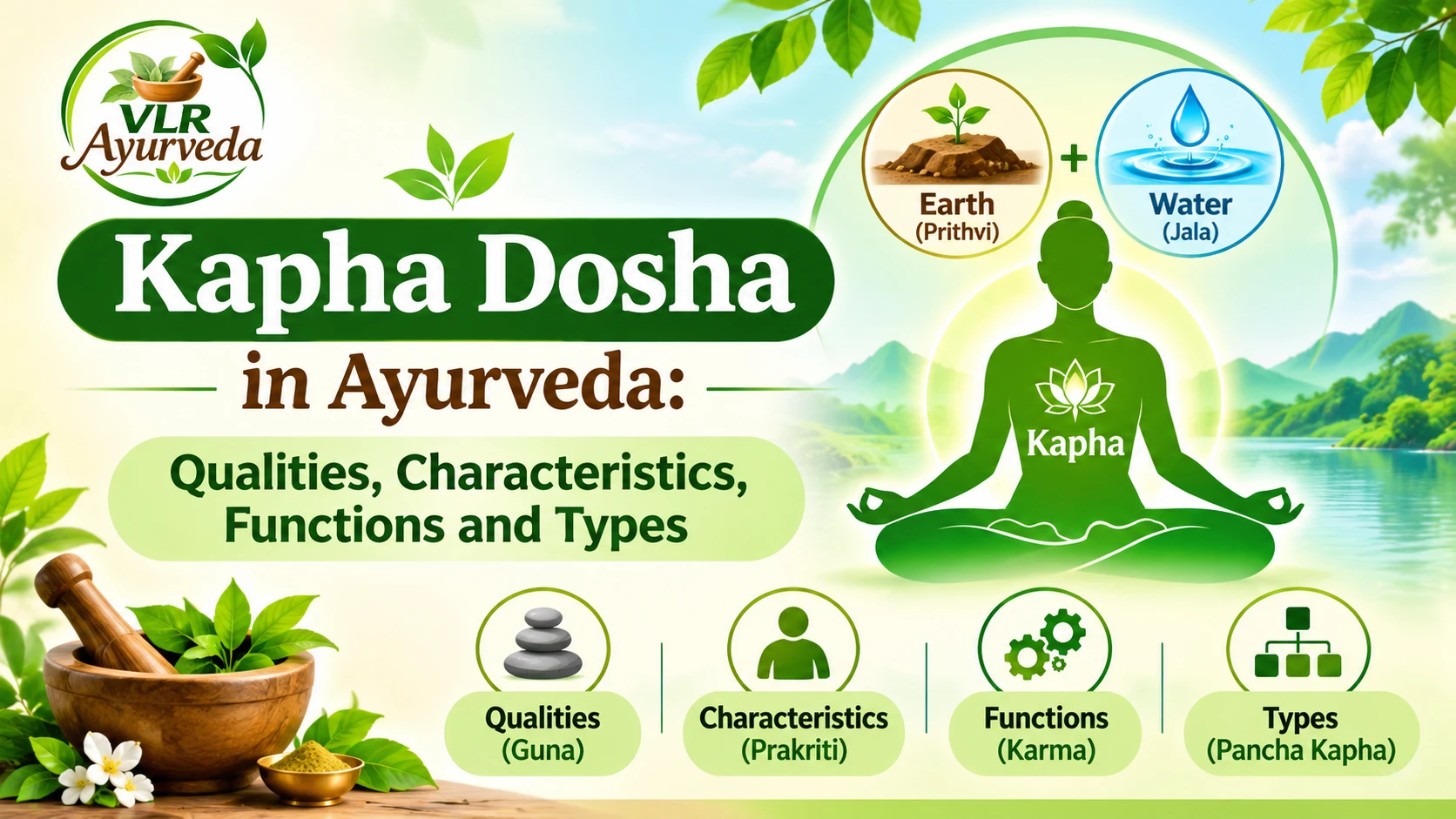
Kapha Dosha is primarily associated with the elements of Earth (Prithvi Mahabhuta) and Water (Jala Mahabhuta). It represents stability, strength, lubrication, nourishment, growth and structural integrity.
In the human body, Kapha is responsible for maintaining the firmness of tissues, providing lubrication to joints, supporting physical strength and contributing to the body’s overall stability.
This educational article from VLR Ayurveda explores the composition, qualities, physical characteristics, psychological tendencies, physiological functions and importance of Kapha Dosha in Ayurvedic health principles.
📖 1. Definition and Meaning of Kapha Dosha
The Sanskrit term Kapha refers to the biological principle associated with the combination of Earth and Water elements.
Kapha represents the qualities and activities associated with:
- 💪 Structural stability of the body.
- 💧 Lubrication of body tissues and joints.
- 🌱 Nourishment and growth.
- 🦴 Strength and firmness of bodily structures.
- ⚖️ Physical and mental stability.
- 🧘 Emotional steadiness and patience.
Kapha is not simply a bodily fluid. It is an Ayurvedic functional principle that represents the qualities and activities associated with Earth and Water.
According to Ayurveda, when Kapha remains balanced, it supports strength, stability, nourishment and smooth functioning of the body.
When Kapha becomes excessive or aggravated, its heavy, cold, moist and stagnant qualities may contribute to various physical and functional disturbances.
🌍 2. Panchamahabhutas – Elements of Kapha Dosha
Ayurveda explains that all living beings and substances are composed of five fundamental elements known as Panchamahabhutas.
These five elements are:
| Sanskrit Name | English Meaning | Symbol |
|---|---|---|
| Akasha Mahabhuta | Space or Ether | 🌌 |
| Vayu Mahabhuta | Air | 🌬️ |
| Agni Mahabhuta | Fire | 🔥 |
| Jala Mahabhuta | Water | 💧 |
| Prithvi Mahabhuta | Earth | 🌍 |
The Tridosha system is based on the predominance of different combinations of these elements.
🧬 Elements Associated with Tridosha
| Dosha | Predominant Elements |
|---|---|
| Vata Dosha | Space and Air |
| Pitta Dosha | Fire |
| Kapha Dosha | Earth and Water |
💧 Why Are Earth and Water Important in Kapha?
The combination of Earth and Water provides an example of the qualities associated with Kapha.
When soil combines with water, it becomes moist, dense, heavy and cohesive. Similarly, Kapha is traditionally associated with qualities such as:
- Heavy
- Moist
- Dense
- Soft
- Stable
- Smooth
- Cold
- Oily
These qualities explain why Kapha is connected with the formation, nourishment and maintenance of bodily structures.
For learners at VLR Ayurveda, understanding this relationship between the five elements and their qualities is fundamental to understanding Kapha Dosha.
📚 Further Reading: Ministry of AYUSH – Government of India
⚖️ 3. Qualities of Kapha Dosha (Kapha Guna)
In Ayurveda, the inherent qualities of a substance or biological principle are known as Gunas.
Kapha possesses qualities that reflect the nature of Earth and Water.
🌿 Nine Major Qualities of Kapha
| Sanskrit Term | English Meaning | General Description |
|---|---|---|
| Guru | Heavy | Associated with heaviness and mass |
| Manda | Slow or Dull | Represents slowness and reduced intensity |
| Hima / Sheeta | Cold | Associated with coolness |
| Snigdha | Unctuous or Oily | Provides lubrication and moisture |
| Shlakshna | Smooth | Represents smoothness |
| Sthira | Stable or Static | Provides firmness and stability |
| Sandra | Dense | Represents compactness and density |
| Mridu | Soft | Associated with softness |
| Picchila | Slimy or Sticky | Represents cohesiveness and stickiness |
🔎 Explanation of Important Kapha Qualities
1. Guru (Heavy) ⚖️
Kapha is traditionally considered heavy because of its association with Earth. This quality contributes to the body’s structural strength and physical stability.
2. Manda (Slow or Dull) 🐢
The slow quality of Kapha is associated with gradual activity and slower physiological processes within the traditional Ayurvedic framework.
3. Sheeta (Cold) ❄️
Kapha has a cooling nature. Excessive exposure to cold and damp conditions is traditionally considered capable of aggravating Kapha.
4. Snigdha (Oily or Unctuous) 💧
This quality supports lubrication and moisture in the body. It is particularly associated with the smooth functioning of joints and tissues.
5. Sthira (Stable) 🧱
Stability is one of the most important characteristics of Kapha. It contributes to firmness, consistency and the ability to maintain bodily structures.
6. Sandra (Dense) 🪨
The dense quality represents compactness and the structural nature of bodily tissues.
7. Mridu (Soft) 🌸
Kapha is associated with softness and smoothness, especially in relation to tissues and body structures.
🍯 Tastes Associated with Increasing Kapha
Ayurveda identifies three tastes that traditionally increase Kapha when consumed excessively:
| Sanskrit Name | English Meaning |
|---|---|
| Madhura Rasa | Sweet taste |
| Amla Rasa | Sour taste |
| Lavana Rasa | Salty taste |
Important distinction: Sweet, sour and salty are classified as tastes (Rasa), not physical qualities (Guna) of Kapha.
🧍 4. Physical Characteristics of Kapha Prakriti
Prakriti refers to an individual’s natural body constitution. According to Ayurveda, each person has a unique combination of Vata, Pitta and Kapha.
Individuals with Kapha predominance are traditionally described as having certain physical characteristics.
These characteristics are general Ayurvedic descriptions rather than fixed features that apply to every individual.
💪 4.1 Body Structure
Kapha-predominant individuals are traditionally associated with:
- A relatively strong and well-developed body structure.
- Strong bones.
- Well-developed muscles.
- A tendency towards a heavier body build.
- Greater ease of gaining weight.
- Difficulty losing weight according to traditional constitutional descriptions.
The heavy and stable qualities of Kapha are used in Ayurveda to explain its relationship with body structure and physical development.
💆 4.2 Skin and Hair
Traditional descriptions of Kapha Prakriti commonly associate it with:
- Thick and relatively abundant hair.
- Soft skin.
- Moist and smooth skin texture.
- A well-nourished physical appearance.
🗣️ 4.3 Voice
Kapha-predominant individuals are traditionally described as having a pleasant, deep or steady voice.
😴 4.4 Sleep Pattern
Individuals with Kapha predominance are traditionally considered to have:
- A tendency towards longer sleep.
- Deep and sound sleep.
- A preference for rest and relaxation.
Excessive sleep or persistent daytime sleepiness, however, should not automatically be attributed to Kapha.
🍽️ 4.5 Digestion and Thirst
Kapha is associated with the slow and heavy qualities.
Consequently, traditional Ayurvedic descriptions may include:
- Relatively slow digestion.
- A tendency towards reduced digestive appetite.
- Less frequent feelings of thirst.
- A sensation of heaviness after eating.
- Slower digestive activity according to the traditional Ayurvedic framework.
These are constitutional descriptions within Ayurveda and are not substitutes for medical assessment of digestive or metabolic symptoms.
🛡️ 4.6 Strength and Resistance
Balanced Kapha is traditionally associated with:
- Physical strength.
- Stability.
- Endurance.
- Tissue nourishment.
- Resistance and resilience.
The traditional description of strong immunity in Kapha-predominant individuals should not be interpreted as proof of greater immune protection against infections.
🧠 5. Psychological and Behavioural Characteristics of Kapha
Kapha is not only associated with physical structure but also with certain psychological and behavioural characteristics in Ayurvedic descriptions.
When balanced, Kapha is traditionally associated with calmness, patience, affection and emotional stability.
🧘 5.1 Calm and Peaceful Nature
Kapha-predominant individuals are traditionally described as calm, peaceful and composed.
They generally prefer a stable environment and may avoid unnecessary conflicts.
❤️ 5.2 Loving and Caring Behaviour
Kapha is associated with nurturing and affectionate qualities.
Such individuals are traditionally described as:
- Loving and caring.
- Kind and supportive.
- Loyal towards family and friends.
- Concerned about the well-being of others.
- Helpful during social gatherings.
They often value long-term relationships and emotional connections.
⏳ 5.3 Patience
Patience is an important characteristic associated with balanced Kapha.
Kapha-predominant individuals are traditionally described as people who do not become angry easily and who may remain calm during challenging situations.
🧠 5.4 Good Memory
Traditional Ayurvedic descriptions associate Kapha with retention, stability and memory.
Kapha-predominant individuals are often described as having good memory retention, particularly for information and relationships that are important to them.
🤝 5.5 Teamwork and Loyalty
Kapha is associated with cooperation and dependability.
People with Kapha predominance are traditionally considered good team players because they may:
- Support colleagues and team members.
- Value teamwork.
- Maintain stable relationships.
- Remain committed to responsibilities.
- Provide emotional support to others.
📋 5.6 Organized and Stable Behaviour
Kapha is associated with stability and consistency.
Kapha-predominant individuals may prefer organized surroundings and predictable routines.
They are traditionally described as being capable of concentrating on one activity for extended periods.
🐢 5.7 Slow Activity and Laziness
The slow and heavy qualities of Kapha may also be reflected in behavioural tendencies.
When excessive, these qualities can be traditionally associated with:
- Slow initiation of tasks.
- Reduced enthusiasm.
- Excessive resting.
- Procrastination.
- Lack of motivation.
- Mental heaviness.
Ayurveda associates aggravated Kapha with lethargy and stagnation. These tendencies should not be used to diagnose depression or any other mental health condition.
💪 6. Important Functions of Kapha Dosha in the Body
Kapha performs several important functions within the Ayurvedic understanding of the human body.
Its primary functions include structural support, nourishment, strength, stability and lubrication.
🦴 6.1 Structural Growth and Development
Kapha is considered responsible for the growth, nourishment and structural development of bodily tissues.
Its Earth element represents firmness and structure, while its Water element contributes moisture and cohesiveness.
Together, these elements support the traditional understanding of bodily growth and development.
🦵 6.2 Lubrication of Joints
One of the important functions of Kapha is maintaining lubrication around joints.
This helps explain its association with:
- Smooth joint movement.
- Flexibility.
- Reduced friction between joint structures.
- Maintenance of joint stability.
🏋️ 6.3 Maintaining Physical Strength
Kapha contributes to physical strength and stability according to Ayurveda.
Balanced Kapha is traditionally associated with bodily endurance and the ability to maintain physical activities.
🧱 6.4 Maintaining Compactness of Body Structures
The dense and stable qualities of Kapha help maintain the compactness and firmness of body structures.
💧 6.5 Nourishment and Moisture
Kapha is associated with nourishment and moisture in various bodily structures.
Its lubricating and cohesive nature is important for understanding its role in supporting bodily tissues.
🧘 6.6 Mental Stability
Kapha is traditionally associated with calmness, patience, emotional stability and memory retention.
These qualities contribute to its importance in both physical and psychological aspects of Ayurvedic health.
🧬 7. Five Types of Kapha Dosha (Pancha Kapha)
Ayurveda describes five functional subdivisions of Kapha known as Pancha Kapha.
Each type performs a particular function in a specific region of the body.
📊 Classification of Five Kapha Types
| Type of Kapha | Traditional Location | Main Function |
|---|---|---|
| Avalambaka Kapha | Chest region | Provides support and stability |
| Kledaka Kapha | Stomach | Moistens and softens food |
| Bodhaka Kapha | Mouth and tongue | Supports taste perception |
| Tarpaka Kapha | Head | Nourishes and supports sensory organs |
| Shleshaka Kapha | Joints | Provides joint lubrication |
🫁 7.1 Avalambaka Kapha
Avalambaka Kapha is traditionally associated with the chest region.
Its primary role is to provide support and stability to important structures in this region and to support other Kapha functions.
🍲 7.2 Kledaka Kapha
Kledaka Kapha is located in the stomach.
Its primary function is to moisten and soften food particles, helping prepare food for digestion.
It contributes to the traditional understanding of moisture and lubrication within the digestive system.
👅 7.3 Bodhaka Kapha
Bodhaka Kapha is associated with the mouth and tongue.
Its main function is related to the perception of taste.
It supports the ability to experience different tastes through the tongue.
🧠 7.4 Tarpaka Kapha
Tarpaka Kapha is traditionally located in the head.
It is associated with nourishment and support of the sensory organs.
🦴 7.5 Shleshaka Kapha
Shleshaka Kapha is present in the joints.
Its primary function is lubrication, which helps support smooth joint movement and maintain the stability of joint structures.
📚 Further Reading: WHO – International Standard Terminologies on Ayurveda
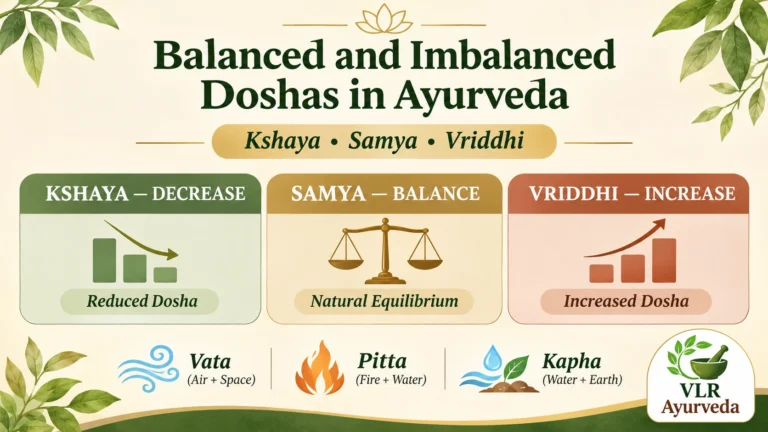
⚖️ 8. Balanced and Aggravated Kapha Dosha
Kapha is essential for maintaining the structural and functional integrity of the body. However, Ayurveda emphasizes that its functions should remain balanced.
✅ 8.1 Characteristics of Balanced Kapha
When Kapha is balanced, it is traditionally associated with:
- 💪 Good physical strength.
- 🦴 Stable body structure.
- 🦵 Proper lubrication of joints.
- 🌱 Nourished tissues.
- 🧘 Calm and peaceful behaviour.
- ❤️ Patience and emotional stability.
- 😴 Good sleep.
- 🧠 Mental steadiness.
⚠️ 8.2 Characteristics of Aggravated Kapha
When Kapha increases excessively, its inherent qualities may become more pronounced.
Traditional descriptions of aggravated Kapha include:
- Heaviness in the body.
- Reduced enthusiasm.
- Excessive sleepiness.
- Sluggishness.
- A tendency towards weight gain.
- Excess mucus and congestion.
- Reduced digestive appetite.
- Mental dullness.
- Low motivation.
These features are traditional Ayurvedic descriptions and cannot independently establish a medical diagnosis.
🌬️ 9. Kapha Dosha and Respiratory Health
Kapha is traditionally associated with moisture, mucus and lubrication.
Excessive Kapha is described in Ayurveda as contributing to increased mucus accumulation and congestion.
Some traditional descriptions associate aggravated Kapha with respiratory complaints such as:
- 🤧 Excess mucus production.
- 😷 Cough.
- 👃 Nasal congestion.
- 🌡️ Cold-like symptoms.
- 🌿 Certain allergic-type complaints.
- 🫁 Upper respiratory discomfort.
However, respiratory infections and allergies have multiple causes. They should not be considered conditions caused by Kapha alone.
Persistent cough, breathing difficulty, fever or recurring respiratory symptoms require appropriate medical evaluation.
🏡 10. Practical Examples of Kapha Qualities in Everyday Life
Understanding Kapha becomes easier when its qualities are connected with familiar everyday examples.
🌿 Examples of Kapha Guna
| Everyday Example | Associated Kapha Quality |
|---|---|
| Soil mixed with water becomes thick and cohesive | Dense and stable |
| Oil provides smoothness and lubrication | Snigdha |
| A heavy object is difficult to move quickly | Guru |
| A person prefers a steady routine | Sthira |
| Thick and moist substances retain their consistency | Picchila |
| A slow-moving process takes more time | Manda |
These examples demonstrate how the qualities of Earth and Water are used in Ayurveda to understand Kapha.
🎯 11. Importance of Kapha Dosha in Ayurveda
Kapha plays an important role in the Ayurvedic understanding of health because it supports the structural and functional aspects of the body.
Its major areas of significance include:
1. 🦴 Structural Stability: Kapha provides the traditional basis for understanding firmness and stability in bodily structures.
2. 🌱 Tissue Nourishment: It is associated with nourishment and the maintenance of bodily tissues.
3. 🦵 Joint Lubrication: Kapha supports the lubrication and smooth movement of joints.
4. 💪 Physical Strength: Balanced Kapha is associated with strength and endurance.
5. 🧘 Mental Stability: Its qualities are traditionally connected with patience, calmness and emotional steadiness.
6. ⚖️ Overall Balance: Kapha works together with Vata and Pitta to maintain the functional balance described by Ayurveda.
For students of VLR Ayurveda, understanding these functions helps build a foundation for learning the relationships between Dosha, Dhatu and Mala.
🌞 12. Daily-Life Applications and General Considerations
Understanding Kapha characteristics can help learners recognize the traditional Ayurvedic relationship between body constitution, qualities and lifestyle.
General principles traditionally associated with Kapha management include:
- 🚶 Maintaining a regular and active daily routine.
- 🏃 Avoiding excessive inactivity.
- 🧘 Giving appropriate attention to physical activity.
- 🍽️ Maintaining balanced eating habits.
- ⚖️ Avoiding habitual overeating.
- 🌅 Maintaining regular sleep and waking schedules.
- 👩⚕️ Seeking individualized Ayurvedic guidance when experiencing persistent symptoms.
These are general educational considerations, not a personalized treatment plan. Dietary restrictions, therapies and medicines should be selected according to an individual’s constitution, health status and professional assessment.
Educational resources from VLR Ayurveda can help learners understand the relationship between traditional Ayurvedic principles and everyday health practices.
🔬 13. Traditional Ayurvedic Understanding and Modern Scientific Evidence
Kapha Dosha is a traditional Ayurvedic concept describing physiological functions through the qualities of Earth and Water.
It should not be directly equated with a single organ, hormone, body fluid, metabolic process or immune mechanism in modern medicine.
Similarly, the traditional physical and psychological characteristics of Kapha Prakriti are not established biomedical diagnostic categories.
Modern scientific research on Ayurveda is ongoing. The National Center for Complementary and Integrative Health (NCCIH) notes that evidence for many Ayurvedic approaches remains limited and that some Ayurvedic preparations may contain potentially toxic heavy metals.
📚 Further Reading: NCCIH – Ayurvedic Medicine: In Depth
Traditional Ayurvedic knowledge and modern scientific findings should therefore be understood in their respective contexts.
🛑 14. Precautions and Safety Considerations
Kapha Prakriti is a traditional constitutional concept. A person’s body weight, sleep pattern, digestive symptoms or personality should not be assessed solely on the basis of Kapha characteristics.
⚠️ Important Precautions
- Do not assume that every person with Kapha predominance will experience weight gain, excessive mucus or sluggish digestion.
- Do not use constitutional descriptions to diagnose respiratory infections or allergies.
- Persistent tiredness, unexplained weight changes or excessive sleepiness require medical assessment.
- Respiratory symptoms such as breathlessness or persistent fever require timely medical attention.
- Do not begin Ayurvedic medicines or herbal formulations without appropriate professional guidance.
- Do not stop prescribed medicines in favour of traditional remedies.
Kapha-related diet and lifestyle recommendations should be individualized by a qualified Ayurvedic practitioner, with appropriate medical supervision wherever necessary.
📝 15. Important Points to Remember
⭐ Key Takeaways About Kapha Dosha
- 🌿 Kapha is one of the three doshas described in Ayurveda.
- 🌍 It is primarily composed of Earth (Prithvi) and Water (Jala).
- ⚖️ Its major qualities include heaviness, coldness, moisture, oiliness, softness, density and stability.
- 🦴 Kapha is associated with structural growth, physical strength and tissue nourishment.
- 🦵 It supports lubrication and smooth movement of joints.
- ❤️ Kapha-predominant individuals are traditionally described as calm, patient, caring and loyal.
- 💪 They may be characterized by a heavier body structure, strong muscles and longer sleep.
- ⚠️ Excessive Kapha is traditionally associated with heaviness, sluggishness and increased mucus.
- 🧬 Kapha has five subdivisions: Avalambaka, Kledaka, Bodhaka, Tarpaka and Shleshaka.
- ⚖️ Kapha functions together with Vata and Pitta to maintain the balance described in Ayurveda.
📚 16. Summary of Kapha Dosha
Kapha Dosha represents the principles of stability, nourishment, strength, lubrication and structural integrity in Ayurveda.
Its composition of Earth and Water explains its major qualities, including heaviness, coldness, moisture, softness, density and stability.
Kapha supports the formation and maintenance of body structures, provides lubrication to joints and contributes to physical and mental stability according to traditional Ayurvedic understanding.
Kapha-predominant individuals are commonly described as calm, patient, loving, loyal and physically strong. However, these characteristics are general constitutional descriptions and may vary between individuals.
Understanding Kapha Dosha is essential for learning the Tridosha system and the relationship between physical constitution, physiological functions and overall health.
VLR Ayurveda emphasizes the importance of understanding each dosha’s qualities and functions as a foundation for studying Ayurvedic principles and maintaining a balanced approach to health.
❓ 17. Frequently Asked Questions (FAQs)
1. 🌿 What is Kapha Dosha in Ayurveda?
Kapha Dosha is one of the three fundamental biological principles in Ayurveda. It is formed from the combination of Earth and Water elements and is associated with stability, strength, lubrication, nourishment and structural development.
2. 🌍 Which elements form Kapha Dosha?
Kapha Dosha is primarily composed of two elements:
- Prithvi Mahabhuta: Earth.
- Jala Mahabhuta: Water.
3. ⚖️ What are the main qualities of Kapha Dosha?
The major qualities of Kapha are Guru (heavy), Manda (slow), Sheeta (cold), Snigdha (unctuous), Shlakshna (smooth), Sthira (stable), Sandra (dense), Mridu (soft) and Picchila (slimy).
4. 💪 What are the physical characteristics of Kapha Prakriti?
Traditional descriptions include a strong body structure, well-developed muscles, strong bones, thicker hair, a pleasant voice and a tendency towards a heavier body build.
5. 🧠 What are the psychological characteristics of Kapha individuals?
Kapha-predominant individuals are traditionally described as calm, loving, caring, patient, loyal, cooperative and emotionally steady.
6. 🧬 What are the five types of Kapha Dosha?
The five subdivisions of Kapha are:
- Avalambaka Kapha.
- Kledaka Kapha.
- Bodhaka Kapha.
- Tarpaka Kapha.
- Shleshaka Kapha.
7. 💧 What is the main function of Kapha Dosha?
Kapha is primarily associated with structural stability, physical strength, tissue nourishment, lubrication, growth and maintenance of bodily structures.
8. ⚖️ Why is Kapha associated with weight gain?
In Ayurvedic theory, Kapha possesses heavy and dense qualities and is associated with structural growth and nourishment. Traditional descriptions therefore associate Kapha predominance with a tendency towards weight gain. However, body weight is influenced by many biological, dietary, genetic and lifestyle factors.
9. 🌬️ Is Kapha responsible for mucus production?
Ayurveda traditionally associates Kapha with moisture, mucus and lubrication. Excessive Kapha is described as being associated with increased mucus and congestion. However, mucus production also has important normal physiological functions, and respiratory conditions have multiple possible causes.
10. ⚠️ What happens when Kapha becomes excessive?
Excessive Kapha is traditionally associated with heaviness, sluggishness, lethargy, excessive sleep, reduced digestive appetite, weight gain tendencies and increased mucus.
11. 🍯 Are sweet and salty tastes associated with Kapha?
Yes. Sweet (Madhura), sour (Amla) and salty (Lavana) tastes are traditionally considered capable of increasing Kapha when consumed excessively.
12. 🎓 Why is understanding Kapha important for Ayurveda students?
Understanding Kapha helps students learn the Tridosha system, the relationship between the five elements and bodily functions, and the Ayurvedic principles of physical structure, nourishment, stability and balance.
📖 References and Further Reading
- Government of India – Ministry of AYUSH
Annual Report 2019–2020.
https://ayush.gov.in/resources/annualReport/Annual-report-2019-20_English.pdf - World Health Organization (WHO)
WHO International Standard Terminologies on Ayurveda. 2023.
https://www.who.int/southeastasia/publications/i/item/9789240064935 - National Center for Complementary and Integrative Health (NCCIH)
Ayurvedic Medicine: In Depth.
https://www.nccih.nih.gov/health/ayurvedic-medicine-in-depth
🌿 VLR Ayurveda – Understanding Ayurveda Through Traditional Knowledge and Scientific Awareness.