Panchamahabhutas in Ayurveda – Meaning, Five Elements, Characteristics and Importance
Panchamahabhutas in Ayurveda – Meaning, Five Elements, Characteristics and Importance
1. Introduction to Panchamahabhutas
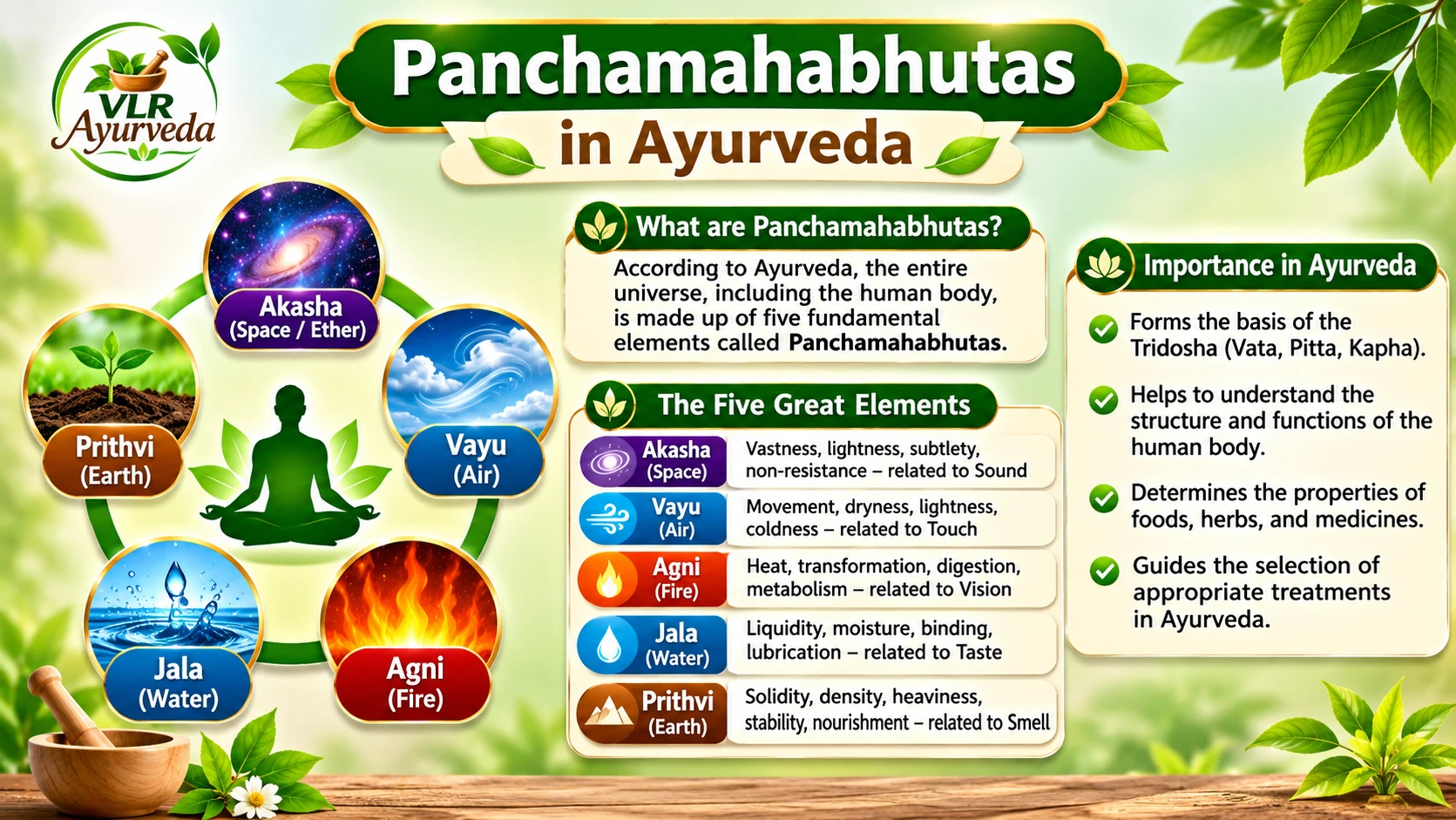
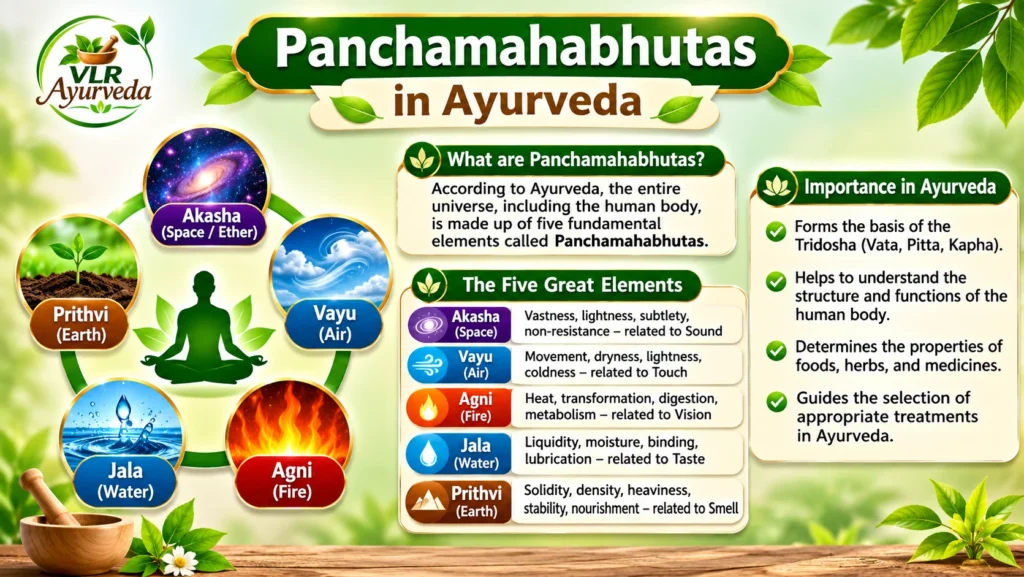
Panchamahabhutas is one of the fundamental concepts of Ayurveda. It explains the basic elements that constitute the universe, including the human body, plants, animals, food items and medicinal substances.
According to Ayurvedic philosophy, everything that exists in the universe is composed of five fundamental elements. These five elements are known as Panchamahabhutas.
The word Panchamahabhuta is derived from two Sanskrit terms:
- Pancha: Five
- Mahabhuta: Great elements or fundamental constituents of existence
Therefore, Panchamahabhutas means the five great elements.
This foundational article is designed as a learning resource for VLR Ayurveda students who want to understand the fundamental principles of Ayurveda.
The Five Mahabhutas
The five fundamental elements are:
- Akasha Mahabhuta – Space or Ether element
- Vayu Mahabhuta – Air element
- Agni Mahabhuta – Fire element
- Jala Mahabhuta – Water element
- Prithvi Mahabhuta – Earth element
These elements form the conceptual foundation of several important Ayurvedic principles, particularly the Tridosha Siddhanta, which explains Vata, Pitta and Kapha.
2. Importance of Panchamahabhutas in Ayurveda
Panchamahabhutas play an important role in understanding the nature and characteristics of different substances.
According to Ayurveda, every substance contains all five elements, but the proportion and predominance of each element vary.
The combination and relative predominance of these elements determine the properties of a substance.
For example:
- The properties of an individual are understood through the predominance of particular elements in their constitution.
- The characteristics of medicinal herbs depend on their elemental composition.
- The properties of food items are understood through their elemental predominance.
- The characteristics and actions of Ayurvedic medicines are also interpreted through this principle.
The same principle is applied when understanding the three Doshas and their role in maintaining bodily functions.
Why Is This Concept Important?
The Panchamahabhuta concept helps in understanding:
- The fundamental constitution of the human body.
- The qualities and characteristics of food.
- The properties of medicinal plants and herbs.
- The relationship between elements and the five senses.
- The formation and characteristics of Tridoshas.
- The principles behind various Ayurvedic treatment approaches.
For VLR Ayurveda learners, understanding this concept provides a foundation for studying Doshas, Prakriti, Dravya, Rasa and other fundamental Ayurvedic principles.
3. Detailed Explanation of the Five Mahabhutas
Each Mahabhuta has its own characteristics, properties and functions. These qualities help explain its predominance in different substances and bodily structures.
3.1 Akasha Mahabhuta – Space Element
Akasha Mahabhuta is the first element among the five Mahabhutas.
Akasha means space, openness or the presence of cavities. It represents the space required for different substances and structures to exist.
When thinking about the space element, qualities such as vastness, openness and hollowness come to mind.
Characteristics of Akasha Mahabhuta:
- Clear
- Light
- Subtle
- Immeasurable
- Spacious
- Non-obstructive
Primary Property: Non-resistance or unobstructed space.
Main Sensory Attribute: Shabda (Sound).
Functions of Akasha Mahabhuta in the Body
Akasha Mahabhuta provides:
- Space and cavities within the body.
- Room for different organs and structures.
- Space within various bodily channels.
- Lightness and subtlety.
- The structural space necessary for the movement of different substances.
Examples:
- The cavities within the body.
- The spaces inside organs.
- Different channels and passages in the body.
- The hollow spaces associated with the ears.
Without space, different bodily structures and processes would not have the room required to exist and function.
3.2 Vayu Mahabhuta – Air Element
Vayu Mahabhuta is the second element among the Panchamahabhutas.
Vayu represents movement, mobility and motion. The movement of air is a useful example for understanding the fundamental quality of this element.
Vayu Mahabhuta evolves from Akasha Mahabhuta.
Characteristics of Vayu Mahabhuta:
- Mobile
- Dry
- Light
- Cold
- Subtle
- Clear
Primary Property: Mobility or movement (Chalatva).
Main Sensory Attribute: Sparsha (Touch).
Functions of Vayu Mahabhuta in the Body
Vayu Mahabhuta is associated with:
- Movement of different body parts.
- Transportation and movement of substances.
- Various physiological movements.
- Activities associated with bodily channels.
- Movement and functioning of Doshas.
In the Ayurvedic understanding, excessive or disturbed Vayu qualities may be associated with tiredness and depletion.
Examples:
- Movement of hands and legs.
- Movement involved in breathing.
- Bodily movement and muscular activities.
- Various transportation processes within the body.
Mobility is the most important characteristic of Vayu Mahabhuta.
3.3 Agni Mahabhuta – Fire Element
Agni Mahabhuta is the third element among the Panchamahabhutas.
Agni represents heat, transformation and metabolic activity.
It is responsible for the transformation of substances and is associated with digestion and metabolism in the Ayurvedic understanding.
Agni Mahabhuta evolves from Vayu Mahabhuta.
Characteristics of Agni Mahabhuta:
- Hot
- Sharp
- Light
- Dry
- Transformative
Primary Property: Heat (Ushnatva).
Main Sensory Attribute: Rupa (Form or Visual Appearance).
Functions of Agni Mahabhuta in the Body
Agni Mahabhuta is associated with:
- Digestion of food.
- Metabolic activities.
- Transformation of substances.
- Production and maintenance of body heat.
- Visual appearance and colour.
- Glow and complexion of the skin.
Examples:
- Digestive processes.
- Metabolism of nutrients.
- Heat-related physiological activities.
- Changes associated with digestion and transformation.
Agni plays an important role in explaining how food is transformed and utilized by the body according to Ayurvedic principles.
3.4 Jala Mahabhuta – Water Element
Jala Mahabhuta, also known as Aap Mahabhuta, is the fourth element among the Panchamahabhutas.
Jala represents water, liquidity, fluidity, moisture and binding properties.
When thinking about water, the qualities of fluidity, softness and lubrication are easily understood.
One of the important properties of Jala Mahabhuta is its ability to bind different substances together.
Example: Binding Property of Water
Consider a quantity of dry soil.
It is difficult to form a solid ball using completely dry soil because the particles do not bind together effectively.
When water is added to the soil, the particles come together and form mud. This makes it possible to create a ball.
This example demonstrates the binding property associated with Jala Mahabhuta.
Characteristics of Jala Mahabhuta:
- Cold
- Liquid
- Soft
- Moist
- Slimy
- Unctuous
- Lubricating
Primary Property: Liquidity (Dravatva).
Main Sensory Attribute: Rasa (Taste).
Functions of Jala Mahabhuta in the Body
Jala Mahabhuta is associated with:
- Providing moisture to body tissues.
- Lubricating different bodily structures.
- Maintaining smoothness.
- Binding cells and tissues.
- Supporting fluid-related functions.
- Maintaining softness and hydration.
Example: Synovial Fluid in Joints
Synovial fluid is a lubricating fluid present within movable joints.
It helps reduce friction between the articulating surfaces of bones during movement.
In the traditional Panchamahabhuta framework, this lubricating and fluid-related function can be understood through the qualities of Jala Mahabhuta.
Without adequate joint lubrication, friction and discomfort may increase.
Therefore, lubrication and moisture are important functional characteristics associated with Jala Mahabhuta.
3.5 Prithvi Mahabhuta – Earth Element
Prithvi Mahabhuta is the fifth and final element among the Panchamahabhutas.
Prithvi represents solidity, stability, density and material structure.
The earth element is associated with solid structures and substances that possess weight and stability.
Prithvi Mahabhuta evolves from Jala Mahabhuta.
Characteristics of Prithvi Mahabhuta:
- Solid
- Dense
- Hard
- Heavy
- Stable
- Rough
Primary Property: Roughness (Kharatva).
Main Sensory Attribute: Gandha (Smell).
Functions of Prithvi Mahabhuta in the Body
Prithvi Mahabhuta is associated with:
- Providing nourishment to body tissues.
- Maintaining structural stability.
- Providing hardness and density.
- Supporting the formation of solid bodily structures.
- Maintaining firmness and stability.
Examples:
The following structures can be understood as having a predominant Prithvi component:
- Bones
- Teeth
- Nails
- Other solid bodily structures
Just as the earth provides a stable foundation, Prithvi Mahabhuta represents stability and structural support within the human body.
4. Comparison of the Five Mahabhutas
The following table summarizes the five elements, their major characteristics, properties and sensory attributes.
| Mahabhuta | Element | Main Characteristics | Primary Property | Sense Attribute |
|---|---|---|---|---|
| Akasha | Space | Light, subtle, spacious | Non-resistance | Shabda – Sound |
| Vayu | Air | Dry, mobile, light, cold | Mobility | Sparsha – Touch |
| Agni | Fire | Hot, sharp, light, dry | Heat | Rupa – Form |
| Jala | Water | Cold, liquid, soft, moist | Liquidity | Rasa – Taste |
| Prithvi | Earth | Solid, dense, hard, heavy | Roughness | Gandha – Smell |
5. Relationship Between Panchamahabhutas and Five Senses
An important principle of Panchamahabhuta Siddhanta is the relationship between the five elements and the five sensory attributes.
According to Ayurveda, each Mahabhuta is associated with a specific sensory attribute known as Tanmatra.
The five sensory attributes are:
- Shabda – Sound
- Sparsha – Touch
- Rupa – Form or Vision
- Rasa – Taste
- Gandha – Smell
These attributes are associated with the five sensory organs.
5.1 Akasha – Shabda (Sound)
- Element: Akasha
- Sensory Attribute: Shabda
- Sense Organ: Ear
- Sense: Hearing
Sound is the primary sensory attribute of Akasha Mahabhuta.
Space provides the condition for sound to be perceived.
5.2 Vayu – Sparsha (Touch)
- Element: Vayu
- Sensory Attribute: Sparsha
- Sense Organ: Skin
- Sense: Touch
Touch is the primary sensory attribute of Vayu Mahabhuta.
Mobility is its chief physical property.
5.3 Agni – Rupa (Form or Vision)
- Element: Agni
- Sensory Attribute: Rupa
- Sense Organ: Eye
- Sense: Vision
Rupa represents form, appearance and visual perception.
The primary property of Agni Mahabhuta is heat.
5.4 Jala – Rasa (Taste)
- Element: Jala
- Sensory Attribute: Rasa
- Sense Organ: Tongue
- Sense: Taste
Taste is the primary sensory attribute of Jala Mahabhuta.
Liquidity is its chief physical property.
5.5 Prithvi – Gandha (Smell)
- Element: Prithvi
- Sensory Attribute: Gandha
- Sense Organ: Nose
- Sense: Smell
Smell is the primary sensory attribute of Prithvi Mahabhuta.
Roughness is its chief physical property.
Five Mahabhutas and Five Sensory Organs – Summary
| Mahabhuta | Tanmatra | Meaning | Sensory Organ |
|---|---|---|---|
| Akasha | Shabda | Sound | Ear |
| Vayu | Sparsha | Touch | Skin |
| Agni | Rupa | Form / Vision | Eye |
| Jala | Rasa | Taste | Tongue |
| Prithvi | Gandha | Smell | Nose |
Thus, the five Mahabhutas are associated with the five sensory experiences of hearing, touch, vision, taste and smell.
6. Evolution of Panchamahabhutas
Another important concept in Ayurveda is the sequential evolution of the five Mahabhutas.
According to this philosophical framework, the five elements evolve in a particular order.
The sequence is:
- Akasha evolves first.
- Vayu evolves from Akasha.
- Agni evolves from Vayu.
- Jala evolves from Agni.
- Prithvi evolves from Jala.
Sequence of Evolution
Akasha → Vayu → Agni → Jala → Prithvi
This sequence explains the relationship between the five elements and the accumulation of their sensory attributes.
Akasha is the first element to evolve, whereas Prithvi is the last element.
7. Accumulation of Gunas in Successive Mahabhutas
One of the most important concepts in Panchamahabhuta Siddhanta is that each successive Mahabhuta inherits the sensory attributes of its predecessor and adds its own specific attribute.
As a result, each successive element has one additional sensory attribute compared with the previous element.
This concept can be understood step by step.
7.1 Akasha Mahabhuta – One Guna
Akasha is the first element.
Its primary sensory attribute is:
- Shabda – Sound
Therefore, Akasha has one primary sensory attribute.
7.2 Vayu Mahabhuta – Two Gunas
Vayu evolves from Akasha.
It inherits the sensory attribute of Akasha and adds its own attribute.
Therefore, Vayu contains:
- Shabda – Sound
- Sparsha – Touch
Vayu has two sensory attributes.
7.3 Agni Mahabhuta – Three Gunas
Agni evolves from Vayu.
It inherits the attributes of the previous elements and adds its own attribute.
Therefore, Agni contains:
- Shabda – Sound
- Sparsha – Touch
- Rupa – Form or Vision
Agni has three sensory attributes.
7.4 Jala Mahabhuta – Four Gunas
Jala evolves from Agni.
It inherits the attributes of Akasha, Vayu and Agni and adds its own attribute.
Therefore, Jala contains:
- Shabda – Sound
- Sparsha – Touch
- Rupa – Form or Vision
- Rasa – Taste
Jala has four sensory attributes.
7.5 Prithvi Mahabhuta – Five Gunas
Prithvi evolves from Jala.
It inherits all the previous sensory attributes and adds Gandha.
Therefore, Prithvi contains:
- Shabda – Sound
- Sparsha – Touch
- Rupa – Form or Vision
- Rasa – Taste
- Gandha – Smell
Prithvi has all five sensory attributes.
Summary of Guna Accumulation
| Mahabhuta | Inherited Attributes | Own Attribute | Total Gunas |
|---|---|---|---|
| Akasha | None | Shabda | 1 |
| Vayu | Shabda | Sparsha | 2 |
| Agni | Shabda, Sparsha | Rupa | 3 |
| Jala | Shabda, Sparsha, Rupa | Rasa | 4 |
| Prithvi | Shabda, Sparsha, Rupa, Rasa | Gandha | 5 |
This table demonstrates how the sensory attributes accumulate in successive Mahabhutas.
8. Paraspara Anupravesha – Mutual Entry of Elements
Paraspara Anupravesha is an important concept associated with the relationship between successive Mahabhutas.
It refers to the presence or entry of the qualities of preceding elements into the successive elements.
For example:
- Vayu contains the quality of Akasha.
- Agni contains the qualities of Akasha and Vayu.
- Jala contains the qualities of Akasha, Vayu and Agni.
- Prithvi contains the qualities of all four preceding elements.
This explains why Prithvi has all five sensory attributes, whereas Akasha has only one.
Understanding the One-Way Sequence
The concept can be understood as a progressive accumulation of qualities.
The qualities are inherited by the successive Mahabhutas in the order of evolution.
There is no reverse entry in this particular sequence. For example, the qualities of Prithvi are not added backward into Akasha.
Why Is Paraspara Anupravesha Important?
This concept explains:
- Why successive elements have additional sensory attributes.
- Why Prithvi possesses all five sensory attributes.
- Why the earlier elements have fewer sensory attributes.
- How the five elements are interconnected.
The principle is also described in Ayurvedic discussions as the entry of qualities from one Mahabhuta into another (Bhootantara Guna Pravesha).
9. Functions of Panchamahabhutas in the Human Body
All five elements are considered fundamental to understanding the constitution and functioning of the human body.
Each element contributes different functional qualities.
| Mahabhuta | Major Functions in the Human Body | Examples |
|---|---|---|
| Akasha | Provides space, hollowness, lightness and subtlety | Body cavities and channels |
| Vayu | Responsible for movement, mobility and transportation | Body movements and breathing-related activities |
| Agni | Associated with digestion, metabolism and heat | Digestive and metabolic processes |
| Jala | Provides moisture, lubrication, softness and binding | Body fluids and joint lubrication |
| Prithvi | Provides nourishment, solidity, density and stability | Bones, teeth and nails |
Combined Importance
The five elements work together to explain different aspects of the body’s structure and functions.
- Akasha provides space.
- Vayu supports movement.
- Agni supports transformation.
- Jala provides moisture and lubrication.
- Prithvi provides structure and stability.
This conceptual relationship is essential for understanding the relationship between the human body and the universe in Ayurveda.
10. Relationship Between Panchamahabhutas and Tridoshas
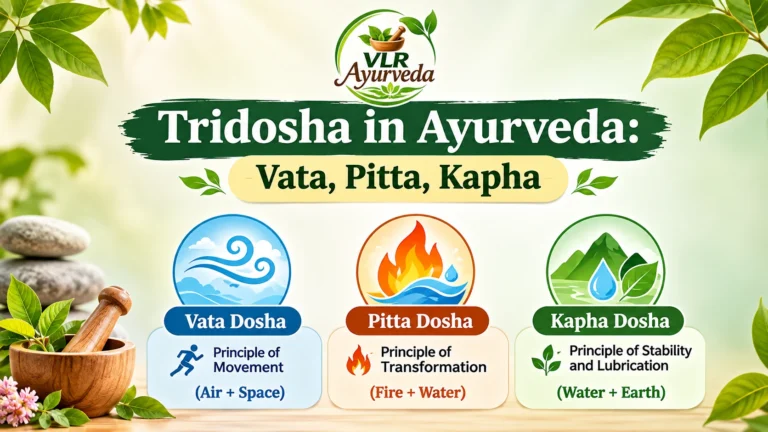
The Panchamahabhuta concept forms the foundation for understanding Tridosha Siddhanta.
According to Ayurveda, the three Doshas are Vata, Pitta and Kapha.
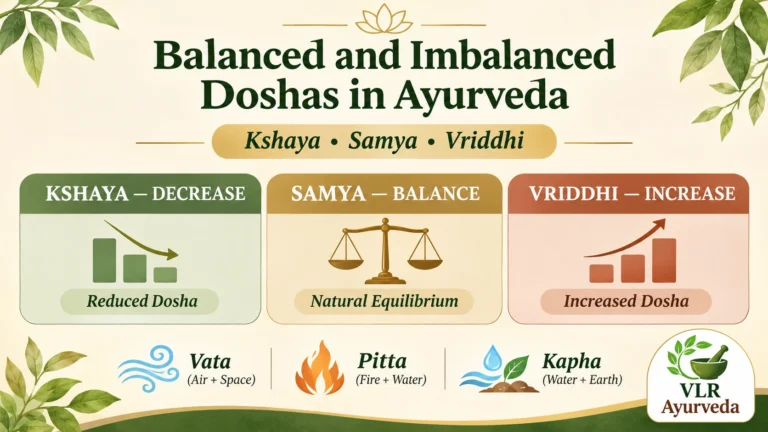
Each Dosha is associated with the predominance of particular Mahabhutas.
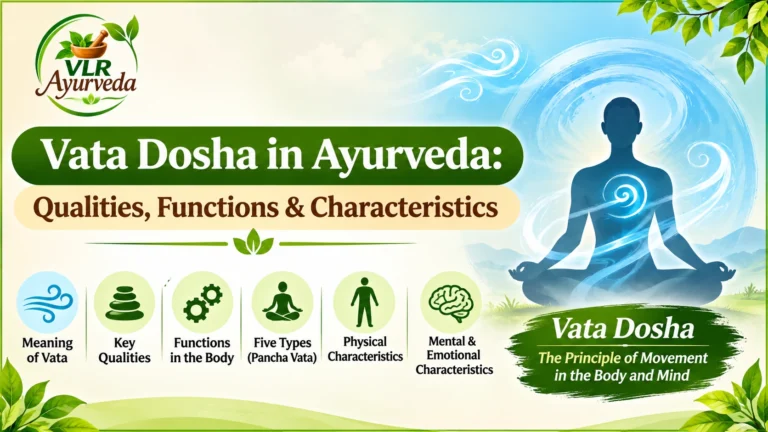
10.1 Vata Dosha
Vata Dosha = Akasha + Vayu
Vata is predominantly associated with the space and air elements.
The major qualities associated with Vata include:
- Mobility
- Lightness
- Dryness
- Subtlety
- Coldness
Vata is associated with movement and transportation processes in the body.
10.2 Pitta Dosha
Pitta Dosha = Agni + Jala
Pitta is predominantly associated with the fire and water elements.
Agni provides the transformative and heating qualities, while Jala contributes its fluid component.
The major qualities associated with Pitta include:
- Heat
- Sharpness
- Transformation
- Digestion
- Metabolic activity
Pitta is associated with digestive and metabolic functions.
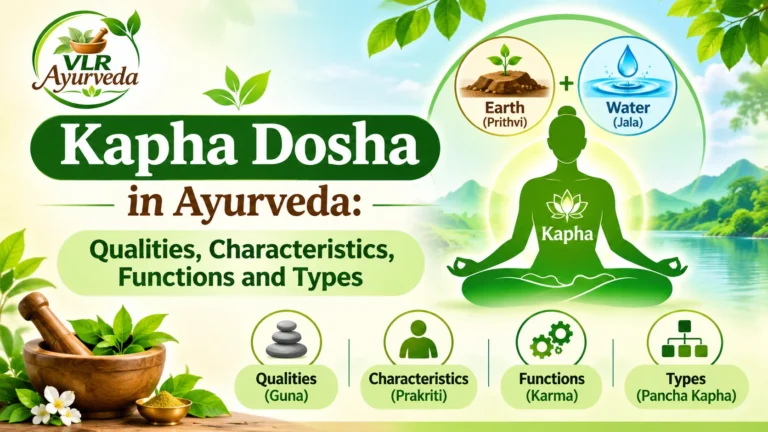
10.3 Kapha Dosha
Kapha Dosha = Jala + Prithvi
Kapha is predominantly associated with the water and earth elements.
The major qualities associated with Kapha include:
- Heaviness
- Stability
- Moisture
- Softness
- Lubrication
- Density
Kapha is associated with structural stability, nourishment and lubrication.
Relationship Between Mahabhutas and Tridoshas
| Dosha | Dominant Mahabhutas | Main Functional Association |
|---|---|---|
| Vata | Akasha + Vayu | Movement and transportation |
| Pitta | Agni + Jala | Digestion and transformation |
| Kapha | Jala + Prithvi | Structure, stability and lubrication |
Important: The two elements shown for each Dosha represent their predominant elemental composition. They do not mean that the remaining Mahabhutas are completely absent from the body.
11. Practical Applications of Panchamahabhuta Siddhanta
Panchamahabhuta Siddhanta is an important conceptual tool for understanding different substances and their properties.
11.1 Understanding Food Items
Food items contain different proportions of the five elements.
The elemental predominance helps explain their characteristics and properties within the Ayurvedic framework.
11.2 Understanding Medicinal Herbs
Different medicinal plants possess different properties.
The Panchamahabhuta concept provides a traditional framework for understanding the nature and characteristics of herbs.
11.3 Understanding Ayurvedic Medicines
The properties of medicinal substances are understood through their elemental composition and associated qualities.
This helps explain why different substances may have different actions.
11.4 Understanding Doshas
The elemental composition of Doshas helps explain their individual characteristics.
For example:
- Vata expresses the qualities of Akasha and Vayu.
- Pitta expresses the qualities of Agni and Jala.
- Kapha expresses the qualities of Jala and Prithvi.
11.5 Understanding Ayurvedic Treatment Principles
Ayurvedic treatment principles consider the qualities and predominance of Doshas and substances.
The properties of food, medicines and therapeutic substances are evaluated within this framework when planning appropriate approaches to maintaining or restoring balance.
Treatment decisions require individual assessment by a qualified Ayurvedic practitioner.
12. Important Points to Remember
The following points are essential when studying Panchamahabhutas:
- Pancha means five, and Mahabhuta means great elements.
- Panchamahabhutas are the five fundamental elements of Ayurveda.
- The five elements are Akasha, Vayu, Agni, Jala and Prithvi.
- All substances are understood as combinations of these five elements.
- The proportion of each element determines the characteristics of a substance within this theory.
- Akasha is associated with sound.
- Vayu is associated with touch.
- Agni is associated with vision.
- Jala is associated with taste.
- Prithvi is associated with smell.
- Akasha is the first element to evolve.
- Prithvi is the last element to evolve.
- Each successive Mahabhuta inherits the sensory attributes of its predecessors.
- Prithvi possesses all five sensory attributes.
- Paraspara Anupravesha explains the progressive entry or inheritance of elemental qualities.
- The Panchamahabhutas provide the foundation for understanding Tridoshas.
- Vata is associated with Akasha and Vayu.
- Pitta is associated with Agni and Jala.
- Kapha is associated with Jala and Prithvi.
13. Summary of Panchamahabhutas
Panchamahabhutas are among the most important fundamental principles of Ayurveda.
The theory explains that the universe and the human body are composed of five basic elements: Akasha, Vayu, Agni, Jala and Prithvi.
Each element has its own characteristics, functions and sensory attributes.
The elements evolve in a sequential order, beginning with Akasha and ending with Prithvi. As the elements evolve, they progressively inherit the sensory attributes of their predecessors.
The five elements also form the conceptual basis for understanding Vata, Pitta and Kapha.
Therefore, Panchamahabhuta Siddhanta is essential for understanding the constitution of the human body, the properties of food and medicinal substances, and the fundamental principles of Ayurvedic practice.
14. Frequently Asked Questions (FAQs)
1. What are Panchamahabhutas in Ayurveda?
Panchamahabhutas are the five fundamental elements described in Ayurveda. They are Akasha (Space), Vayu (Air), Agni (Fire), Jala (Water) and Prithvi (Earth).
2. What is the meaning of Pancha Mahabhuta?
Pancha means five, while Mahabhuta means great elements. Together, the term refers to the five fundamental elements.
3. Which is the first Mahabhuta?
Akasha Mahabhuta is the first element in the traditional sequence of evolution.
4. Which is the last Mahabhuta?
Prithvi Mahabhuta is the fifth and final element in the sequence.
5. What are the five sensory attributes of Panchamahabhutas?
The five sensory attributes are:
- Shabda – Sound
- Sparsha – Touch
- Rupa – Form or Vision
- Rasa – Taste
- Gandha – Smell
6. What is the relationship between Panchamahabhutas and Tridoshas?
The three Doshas are associated with the following elements:
- Vata – Akasha and Vayu
- Pitta – Agni and Jala
- Kapha – Jala and Prithvi
7. What is Paraspara Anupravesha?
Paraspara Anupravesha describes the progressive inheritance of the qualities of preceding Mahabhutas by successive Mahabhutas.
8. How many Gunas does Prithvi Mahabhuta have?
Prithvi has five sensory attributes: Shabda, Sparsha, Rupa, Rasa and Gandha.
9. Why is Panchamahabhuta Siddhanta important in Ayurveda?
It provides a fundamental understanding of the human body’s constitution, the properties of food and medicines, the relationship between the five senses and the elemental basis of Tridoshas.
10. Are Panchamahabhutas the same as modern chemical elements?
No. Panchamahabhutas are traditional Ayurvedic philosophical and functional principles. They should not be directly equated with the chemical elements of the modern periodic table.
11. What is the relationship between VLR Ayurveda and Panchamahabhuta learning?
Panchamahabhuta Siddhanta is a foundational subject for studying Ayurvedic principles such as Tridosha, Prakriti, Rasa and Dravya. It is an important topic for VLR Ayurveda learners.
15. Further Reading and Reference Resources
The following resources provide additional information about Ayurvedic fundamental principles and Panchamahabhuta Siddhanta.
- World Health Organization (WHO) – International Standard Terminologies on Ayurveda
https://www.who.int/publications/i/item/9789240064935 - Central Council for Research in Ayurvedic Sciences (CCRAS) – Ayurveda: The Science of Life
https://ccras.nic.in/wp-content/uploads/2024/07/AYURVEDA_The_Science_of_LifeDossier.pdf - Charaka Samhita Online – Panchamahabhuta
https://www.carakasamhitaonline.com/index.php?title=Mahabhuta
Educational Note: The Panchamahabhuta concept is presented as a traditional Ayurvedic framework. Its descriptions should be understood within the context of Ayurvedic philosophy and classical principles rather than interpreted as direct scientific equivalences to modern anatomy, chemistry or physiology.
VLR Ayurveda can use this article as a foundational study reference for learners progressing to the next topics in Ayurveda, including Tridosha Siddhanta, Prakriti and the fundamental properties of Dravya.