Pitta Dosha in Ayurveda: Characteristics, Functions, Qualities and Body Type
🌿 Pitta Dosha in Ayurveda: Meaning, Functions, Qualities, Physical and Emotional Characteristics
🔥 1. Introduction to Pitta Dosha
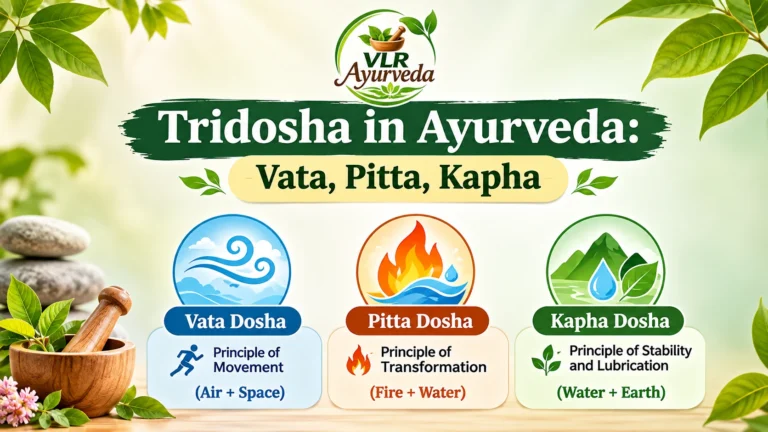
Pitta Dosha is one of the three fundamental biological principles described in Ayurveda. The three Doshas are:
- 🌬️ Vata Dosha
- 🔥 Pitta Dosha
- 🌊 Kapha Dosha
Each Dosha represents a combination of elemental qualities that influence different physiological and psychological activities according to traditional Ayurvedic principles.
Pitta Dosha is primarily associated with two elements:
- 🔥 Fire (Agni)
- 💧 Water (Jala)
Among these two elements, Fire is more dominant, while Water plays a supporting role.
Pitta represents the principle of transformation in the human body. It is traditionally associated with digestion, metabolism, body temperature, and various processes that convert food and other substances into usable forms.
Understanding Pitta Dosha helps learners explore the relationship between elemental qualities, digestion, physical constitution, and emotional characteristics.
At VLR Ayurveda, understanding the three Doshas provides an important foundation for learning traditional Ayurvedic concepts and individual constitution.
📖 2. Definition and Meaning of Pitta Dosha
The word Pitta refers to the transformative principle in Ayurveda.
According to traditional Ayurvedic philosophy, Pitta is responsible for transformation and metabolic activities throughout the body.
⚙️ Examples of Pitta’s Transformative Functions
- 🍚 Food is transformed into nutrients through digestive processes.
- ⚡ Nutrients are utilized by the body for its activities.
- 🌡️ Body temperature is maintained through physiological processes.
- 🧠 Mental experiences are processed, understood, and interpreted.
Pitta is therefore traditionally described as the energy or principle of transformation.
In simple words: Pitta represents the processes that convert, transform, digest, and regulate activities within the body and mind.
🔥 3. Elements of Pitta Dosha
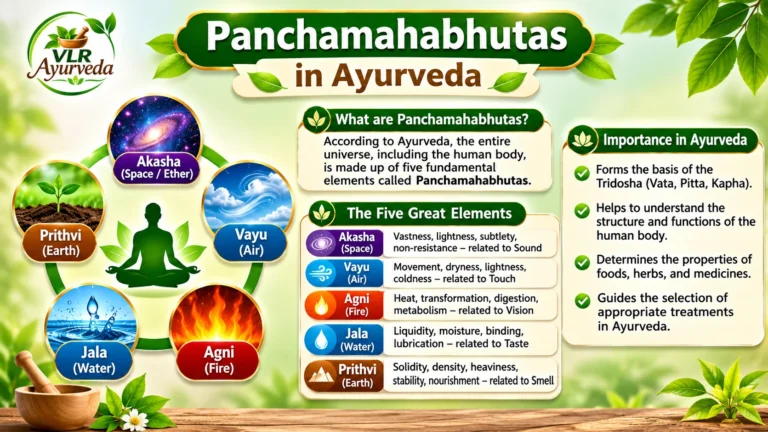
Pitta Dosha consists of two elements:
- 🔥 Agni (Fire)
- 💧 Jala (Water)
Although both elements contribute to Pitta, Fire is considered dominant.
| Element | Sanskrit Name | Significance |
|---|---|---|
| 🔥 Fire | Agni | Heat, transformation and metabolic activity |
| 💧 Water | Jala | Liquid and supporting qualities |
🔥 3.1 Fire Element (Agni)
The Fire element is the dominant component of Pitta Dosha.
Its traditional associations include:
- Digestion and transformation.
- Metabolic processes.
- Heat production.
- Conversion of food into usable substances.
- Sharpness and intensity.
Example: The transformation of food during digestion is traditionally understood through the principle of Agni.
💧 3.2 Water Element (Jala)
Water is the supporting element of Pitta.
It represents the liquid and slightly oily qualities that distinguish Pitta from the pure concept of Fire.
The combination of Fire and Water creates the characteristic qualities attributed to Pitta in Ayurveda.
⚙️ 4. Important Functions of Pitta Dosha
Pitta is associated with several important functions in the Ayurvedic understanding of the human body.
🍽️ 4.1 Digestion of Food
One of the major functions associated with Pitta is digestion.
Pitta is closely connected with Agni, the principle of digestive fire.
It represents the processes through which food is transformed into substances that the body can utilize.
Example:
When a person eats rice, vegetables, fruits, or other foods, the digestive system breaks them down and the body absorbs and utilizes nutrients.
Ayurveda explains this transformation through the concepts of Agni and Pitta.
⚡ 4.2 Regulation of Metabolism
Pitta is traditionally responsible for metabolic transformation.
Metabolism includes the chemical processes through which the body:
- Obtains energy.
- Builds substances.
- Breaks down nutrients.
- Maintains physiological functions.
Ayurvedic philosophy associates these transformative activities with Pitta.
🌡️ 4.3 Regulation of Body Temperature
Pitta is associated with the heat-producing and temperature-related functions of the body.
People with Pitta-predominant Prakriti are traditionally described as having greater sensitivity to heat and warm environmental conditions.
However, modern body-temperature regulation involves complex physiological mechanisms.
🧬 4.4 Relationship with Hormonal Activities
Traditional descriptions sometimes associate Pitta with regulatory and metabolic processes that may be compared with hormonal activities.
However, Pitta should not be understood as a specific hormone or endocrine gland.
There is no established scientific evidence that Pitta directly controls hormonal balance in the modern biomedical sense.
🧠 4.5 Processing of Mental Experiences
Pitta is not limited to physical digestion in Ayurvedic philosophy.
It is also associated with the ability to process and understand experiences at the psychological level.
Examples include:
- Understanding a new concept.
- Analyzing information.
- Making decisions.
- Learning from previous experiences.
- Interpreting situations.
The expression “digesting experiences” is a traditional way of describing mental processing and understanding.
📚 Reference: Caraka Samhita Online – Pitta Dosha
🔍 5. Qualities and Attributes of Pitta Dosha (Pitta Gunas)
In Ayurveda, the characteristics of each Dosha are understood through its Gunas, meaning qualities or attributes.
Pitta has a combination of qualities associated with Fire and Water.
The commonly described Pitta attributes include:
| Sanskrit Term | English Meaning | Traditional Significance |
|---|---|---|
| 🔥 Ushna | Hot | Heat and transformation |
| ⚡ Tikshna | Sharp or penetrating | Intensity and sharpness |
| 🍃 Laghu | Light | Lightness |
| 💧 Drava | Liquid | Flowing or liquid characteristics |
| 🪔 Snigdha | Slightly oily or unctuous | Oiliness |
| 🌊 Sara | Flowing or mobile | Movement and flow |
🪔 5.1 Oily Nature (Snigdha)
Pitta is traditionally described as having a slightly oily or unctuous quality.
This quality contributes to its distinctive nature when compared with the dry quality associated with Vata.
🔥 5.2 Hot Nature (Ushna)
Heat is one of the most important characteristics of Pitta.
Because Fire is the dominant element, Pitta is traditionally associated with warmth and temperature-related functions.
People with Pitta predominance may be described as having warm hands and feet and greater discomfort in hot weather.
⚡ 5.3 Sharp or Penetrating Nature (Tikshna)
Pitta is associated with sharpness and intensity.
This quality is traditionally connected with strong digestive activity, analytical ability, and quick understanding.
Terminology note: Some informal descriptions use the word “absorbent” for this characteristic. However, sharp or penetrating is the more commonly used translation of Tikshna in classical descriptions of Pitta.
🍃 5.4 Light Nature (Laghu)
Lightness is another attribute of Pitta.
It is associated with the relatively light and active characteristics of this Dosha.
💧 5.5 Liquid Nature (Drava)
Pitta also possesses liquid characteristics because of its association with the Water element.
This quality distinguishes Pitta from the predominantly dry characteristics traditionally associated with Vata.
🌶️ 6. Tastes Associated with Pitta Dosha
Ayurveda recognizes six major tastes, known as Shad Rasa.
Three tastes are traditionally associated with increasing Pitta:
| Taste | Sanskrit Name | Relationship with Pitta |
|---|---|---|
| 🍋 Sour | Amla | Increases Pitta |
| 🧂 Salty | Lavana | Increases Pitta |
| 🌶️ Pungent | Katu | Increases Pitta |
According to the Ayurvedic principle of similar qualities increasing similar qualities, foods possessing heat, sharpness, and other Pitta-associated characteristics are traditionally considered capable of aggravating Pitta.
This is a traditional classification, not a substitute for individualized nutritional advice.
🧍 7. Physical Characteristics of Pitta-Predominant Prakriti
In Ayurveda, Prakriti refers to an individual’s inherent constitutional nature.
A person with Pitta-predominant Prakriti is traditionally described as having certain physical characteristics.
These characteristics are general Ayurvedic descriptions. They do not necessarily apply to every individual.
🏃 7.1 Medium Body Structure
People with Pitta predominance are traditionally described as having:
- Medium body size.
- Moderate body weight.
- Moderately developed muscles.
- Athletic or well-proportioned body structure.
They are often described as neither extremely thin nor excessively heavy.
🍽️ 7.2 Strong Digestion and Appetite
Strong digestion and appetite are commonly associated with Pitta-predominant individuals in Ayurvedic descriptions.
Typical characteristics include:
- Strong appetite.
- Regular hunger.
- Relatively strong digestive capacity.
- Frequent desire for food.
- Discomfort when meals are delayed for a long time.
Example: A person may feel hungry again a few hours after eating a meal.
Traditional Ayurvedic descriptions associate this pattern with strong Pitta and digestive Agni. However, frequent hunger alone does not establish a person’s Prakriti or indicate a particular medical condition.
✨ 7.3 Lustrous Complexion
Pitta-predominant individuals are traditionally described as having a bright or lustrous complexion.
Their skin may be characterized as:
- Bright-looking.
- Sensitive.
- Warm.
- Sometimes oily.
- Prone to certain skin complaints in traditional descriptions.
Individual skin characteristics vary considerably and cannot be reliably determined by Dosha classification alone.
💇 7.4 Hair Characteristics
Traditional descriptions associate Pitta-predominant Prakriti with:
- Soft and fine hair.
- Relatively oily hair.
- Early greying in some individuals.
- A tendency toward hair thinning or hair fall.
These are traditional constitutional descriptions, not scientifically established predictions of hair loss or greying.
🌡️ 7.5 Warm Hands and Feet
Pitta-predominant people are traditionally described as having warm hands and feet.
This characteristic is associated with the dominant Fire element.
☀️ 7.6 Sensitivity to Hot Weather
Another commonly described physical characteristic is difficulty tolerating excessive heat.
For example:
- Discomfort during summer.
- Preference for cooler environments.
- Feeling uncomfortable in hot surroundings.
- Greater sensitivity to intense heat.
This traditional description should not be used to diagnose a temperature-regulation disorder.
💦 7.7 Sweating and Body Odour
Pitta-predominant individuals are traditionally described as having a tendency toward:
- Excessive sweating.
- Noticeable body odour.
- Discomfort in hot weather.
Sweating and body odour can also be influenced by genetics, physical activity, environmental temperature, diet, hormones, and medical conditions.
⚠️ 7.8 Other Physical Tendencies
Traditional Ayurvedic descriptions also associate Pitta predominance with:
- Greater sensitivity to physical exertion.
- Discomfort during excessive heat exposure.
- A tendency toward certain inflammatory complaints.
- A tendency toward some skin-related problems.
These descriptions are not medical diagnoses. Persistent inflammation, unusual sweating, skin disease, or unexplained changes in body temperature require appropriate medical evaluation.
📋 Physical Characteristics – Quick Reference
| Characteristic | Traditional Pitta Description |
|---|---|
| Body structure | Medium and athletic |
| Body weight | Moderate |
| Digestion | Strong |
| Appetite | Strong and frequent |
| Complexion | Bright or lustrous |
| Skin | Sensitive and sometimes oily |
| Hair | Soft, fine, and sometimes oily |
| Hair changes | Early greying or hair fall may be described |
| Hands and feet | Warm |
| Weather preference | Often prefers cooler conditions |
| Sweating | May be comparatively high |
| Body odour | May be noticeable |
For learners at VLR Ayurveda, these characteristics are useful for understanding the traditional description of Pitta Prakriti, provided that they are interpreted as tendencies rather than fixed rules.
🧠 8. Emotional and Psychological Characteristics of Pitta Dosha
Ayurvedic descriptions also associate Pitta predominance with certain mental and emotional tendencies.
Pitta represents transformation not only at the physical level but also in traditional explanations of intellectual and psychological activities.
😊 8.1 Attractive and Social Personality
Pitta-predominant individuals are traditionally described as having an attractive and confident personality.
They are often characterized as:
- Socially active.
- Comfortable interacting with people.
- Confident in communication.
- Capable of building relationships.
- Interested in social activities.
They may find it relatively easy to interact with different groups of people.
⚡ 8.2 Quick Decision-Making Ability
Pitta is associated with sharpness and clarity.
Therefore, individuals with Pitta predominance are traditionally described as:
- Quick thinkers.
- Analytical.
- Clear in their thinking.
- Capable of making decisions quickly.
- Focused on understanding situations.
Example: When presented with a problem at work, a Pitta-predominant individual may prefer to analyze the situation and decide on a practical solution.
🧠 8.3 Strong Intellectual Ability
Another commonly described characteristic is a powerful intellect.
Traditional descriptions associate Pitta with:
- Analytical thinking.
- Strong understanding.
- Concentration.
- Memory.
- Problem-solving ability.
These descriptions represent traditional personality associations, not scientifically validated predictions of intelligence or memory performance.
👑 8.4 Leadership Qualities
Pitta-predominant individuals are traditionally considered to have natural leadership tendencies.
They may demonstrate:
- Confidence.
- Responsibility.
- Clear communication.
- Decision-making ability.
- Discipline.
- Goal-oriented behaviour.
Example: In a workplace, a person with these characteristics may be comfortable managing a team and organizing tasks.
🏆 8.5 Competitive Nature
Competition is another important personality characteristic associated with Pitta.
Pitta-predominant individuals are traditionally described as:
- Enjoying challenges.
- Having a strong desire to succeed.
- Setting ambitious goals.
- Working toward achievements.
- Preferring to win competitions.
Example: A person may enjoy participating in business competitions, examinations, sports, or professional challenges.
💪 8.6 Hardworking and Disciplined Nature
Pitta is also associated with determination and organized activity.
Traditional descriptions include:
- Hardworking behaviour.
- Discipline.
- Focus on goals.
- Strong commitment.
- Consistency in completing responsibilities.
🗣️ 8.7 Clear Communication
Pitta-predominant people are often described as direct and clear communicators.
They may prefer:
- Logical conversations.
- Specific explanations.
- Clear instructions.
- Direct communication.
- Result-oriented discussions.
😠 8.8 Anger and Hot Temperament
One of the important emotional characteristics traditionally associated with Pitta is anger.
Pitta is associated with the Hot quality, which is reflected metaphorically in descriptions of emotional intensity.
Some characteristics include:
- Strong emotional reactions.
- Irritability under pressure.
- Impatience.
- Intense anger when provoked.
- A preference for situations to be organized and controlled.
Traditional descriptions may portray such individuals as not reacting to every minor issue but expressing anger intensely once a personal limit is crossed.
Emotional responses are influenced by many factors, including individual experiences, stress, environment, and psychological health. They should not be determined solely by Dosha classification.
💰 8.9 Financial and Lifestyle Tendencies
Some traditional personality descriptions associate Pitta-predominant individuals with ambition and the ability to earn money.
They may also be described as having a preference for luxury, comfort, and high-quality possessions.
These observations are generalized personality descriptions rather than reliable indicators of financial ability or spending behaviour.
📋 Emotional Characteristics – Quick Reference
| Emotional Characteristic | Traditional Description |
|---|---|
| Personality | Attractive and confident |
| Social behaviour | Interacts easily with people |
| Thinking | Sharp and analytical |
| Decision-making | Quick |
| Memory | Traditionally described as strong |
| Concentration | Focused |
| Leadership | Naturally inclined toward leadership |
| Competition | Enjoys challenges and winning |
| Communication | Clear and direct |
| Work habits | Hardworking and disciplined |
| Emotional tendency | May experience intense anger |
| Lifestyle preferences | May enjoy luxury and comfort |
🏡 9. Practical Examples of Pitta Characteristics
The following examples help explain how Pitta characteristics are described in everyday life.
🍽️ Example 1: Strong Appetite
A person regularly feels hungry and prefers to eat meals at consistent times.
Traditional Ayurveda may associate this tendency with strong digestive Agni and Pitta predominance.
☀️ Example 2: Sensitivity to Summer Heat
A person feels uncomfortable when exposed to intense summer temperatures and prefers cooler environments.
This is consistent with the traditional description of Pitta’s hot quality.
🧩 Example 3: Quick Decision-Making
A person quickly evaluates a work-related problem, identifies possible solutions, and makes a decision.
Traditional Ayurvedic descriptions associate this analytical tendency with Pitta.
🏆 Example 4: Competitive Behaviour
A person enjoys taking challenges, participating in competitions, and achieving professional goals.
This is another psychological tendency traditionally associated with Pitta.
😠 Example 5: Strong Emotional Reactions
A person generally communicates confidently but becomes intensely irritated when under pressure or when expectations are not met.
Traditional descriptions may associate this tendency with Pitta’s hot and sharp qualities.
Note: These examples are educational illustrations and cannot be used independently to determine a person’s Dosha constitution.
🌱 10. Importance of Understanding Pitta Dosha
Understanding Pitta is important for learning the Ayurvedic framework of the three Doshas.
It helps explain:
- 🔥 The relationship between Fire and Water elements.
- 🍽️ The traditional understanding of digestion and metabolism.
- ⚙️ The role of Agni in Ayurvedic physiology.
- 🌡️ The significance of hot, sharp, light, and liquid qualities.
- 🧍 The traditional characteristics of Pitta-predominant Prakriti.
- 🧠 The relationship between constitutional descriptions and psychological tendencies.
In VLR Ayurveda educational studies, Pitta should be understood alongside Vata and Kapha because the three Doshas together form a central framework of traditional Ayurvedic philosophy.
🔬 11. Traditional Ayurvedic Concepts and Modern Scientific Understanding
It is important to distinguish Ayurvedic concepts from modern biomedical findings.
Pitta is a traditional explanatory framework. Modern medicine studies digestion, metabolism, body temperature, hormones, and emotional regulation through identifiable physiological and biochemical mechanisms.
| Topic | Traditional Ayurvedic Understanding | Modern Scientific Understanding |
|---|---|---|
| Pitta | Principle of transformation | Not an established biomedical entity |
| Agni | Digestive and transformative principle | Digestion involves enzymes, acids, organs, and metabolic pathways |
| Body temperature | Associated with Pitta | Regulated through physiological thermoregulation |
| Metabolism | Associated with Pitta activity | Involves numerous biochemical reactions |
| Hormonal regulation | Sometimes associated with Pitta | Regulated by the endocrine system and other physiological mechanisms |
| Prakriti | Inherent constitutional classification | Not equivalent to a medically validated diagnostic classification |
📚 A scholarly discussion of the Ayurvedic Dosha framework and its attributes is available in A Complex, Nonlinear Dynamic Systems Perspective on Ayurveda and Ayurvedic Research.
Although traditional Ayurvedic concepts are important for understanding Ayurveda, scientific evidence supporting individual health claims varies. The existence of a traditional concept does not automatically establish a corresponding physiological mechanism.
⚠️ 12. Precautions and Important Considerations
Understanding Pitta characteristics should not lead to self-diagnosis or unnecessary treatment.
Important Precautions
- Do not determine your complete health condition from Pitta characteristics alone.
- Do not assume that strong appetite always indicates healthy digestion.
- Do not interpret body heat or excessive sweating as proof of Pitta aggravation.
- Do not assume that all skin conditions are caused by Pitta.
- Avoid taking Ayurvedic medicines or herbal preparations without appropriate professional guidance.
- Do not discontinue prescribed medicines based on Ayurvedic constitutional descriptions.
- Seek medical evaluation for persistent digestive problems, unexplained weight changes, excessive sweating, skin inflammation, or other concerning symptoms.
Some Ayurvedic preparations may contain potentially harmful amounts of lead, mercury, or arsenic. Product quality and safety should therefore be considered carefully.
📚 For additional information, refer to the National Center for Complementary and Integrative Health (NCCIH) guidance on Ayurvedic Medicine.
For treatment-related decisions, consult a qualified Ayurvedic practitioner and an appropriate healthcare professional.
⭐ 13. Important Points to Remember
- 🔥 Pitta is one of the three Doshas in Ayurveda.
- 💧 Pitta consists of Fire (Agni) and Water (Jala).
- 🔥 Fire is the dominant element of Pitta.
- 🍽️ Pitta is traditionally associated with digestion and metabolism.
- ⚙️ It represents the principle of transformation.
- 🔍 Its major qualities include hot, sharp, light, liquid, and slightly oily.
- 🌶️ Sour, salty, and pungent tastes are traditionally associated with increasing Pitta.
- 🧍 Pitta-predominant individuals are traditionally described as having medium body structures and strong appetites.
- 🌡️ Warm hands and feet and sensitivity to hot weather are commonly described physical tendencies.
- 🧠 Sharp thinking, leadership, competitiveness, and intense emotional reactions are traditionally associated psychological characteristics.
- ⚕️ Prakriti characteristics are general descriptions, not medical diagnoses.
- 🔬 Traditional Ayurvedic explanations should be distinguished from scientifically established physiological mechanisms.
📝 14. Summary
Pitta Dosha is an important concept in Ayurveda, representing the combination of Fire and Water elements, with Fire being dominant. It is traditionally associated with digestion, metabolism, transformation, and body-temperature-related functions.
Its main qualities include hot, sharp, light, liquid, and slightly oily characteristics. Sour, salty, and pungent tastes are traditionally associated with increasing Pitta.
People with Pitta-predominant Prakriti are traditionally described as having medium body structures, strong appetites, warm hands and feet, and sensitivity to heat.
Psychological descriptions include analytical thinking, leadership, competitiveness, discipline, and intense emotional reactions.
Understanding Pitta alongside Vata and Kapha helps develop a broader understanding of Ayurvedic constitutional principles.
VLR Ayurveda emphasizes learning these concepts with attention to traditional terminology, individual differences, and the distinction between traditional explanations and modern scientific evidence.
❓ 15. Frequently Asked Questions (FAQs)
1. 🔥 What is Pitta Dosha in Ayurveda?
Pitta Dosha is one of the three fundamental Doshas in Ayurveda. It is composed of Fire and Water elements and represents the traditional principle of transformation, digestion, and metabolism.
2. 💧 Which elements constitute Pitta Dosha?
Pitta Dosha consists of Agni (Fire) and Jala (Water). Fire is considered the dominant element.
3. 🔍 What are the main qualities of Pitta Dosha?
The commonly described qualities are hot, sharp, light, liquid, and slightly oily.
4. ⚙️ What are the main functions of Pitta Dosha?
Pitta is traditionally associated with digestion, metabolism, transformation, body temperature, and the processing of mental experiences.
5. 🧍 What are the physical characteristics of Pitta Prakriti?
Traditional descriptions include a medium body structure, strong appetite, warm hands and feet, sensitive or oily skin, and sensitivity to hot weather.
6. 🧠 What are the emotional characteristics of Pitta Dosha?
Pitta-predominant individuals are traditionally described as analytical, confident, competitive, disciplined, clear in communication, and inclined toward leadership. Intense anger may also be described as a tendency.
7. 🌶️ Which tastes increase Pitta Dosha?
Sour (Amla), salty (Lavana), and pungent (Katu) tastes are traditionally associated with increasing Pitta.
8. ⚡ Is Pitta Dosha the same as body metabolism?
No. Pitta is an Ayurvedic conceptual framework associated with transformation and metabolism. Modern metabolism refers to a complex collection of biochemical processes.
9. 🌿 Does everyone have Pitta Dosha?
According to Ayurveda, all three Doshas are present in every individual, but their proportions differ. A person’s Prakriti is traditionally understood through the relative predominance of these Doshas.
10. ⚕️ Can Pitta characteristics diagnose a medical condition?
No. Pitta characteristics are traditional constitutional descriptions and should not be used as medical diagnostic criteria. Medical concerns require appropriate healthcare evaluation.
🌿 Educational Note
This article explains traditional Ayurvedic concepts for educational purposes. It is not a substitute for professional medical advice, diagnosis, or treatment.