Balanced and Imbalanced Doshas in Ayurveda – Kshaya, Samya and Vriddhi
Balanced and Imbalanced States of Tridosha in Ayurveda: Dosha Kshaya, Samya and Vriddhi
🌿 Balanced and Imbalanced States of Tridosha in Ayurveda
1. Introduction
According to Ayurveda, maintaining the balance of the three biological energies, Vata, Pitta and Kapha, is essential for preserving health and supporting the normal functioning of the body and mind.
These three doshas regulate various physiological activities and work together to maintain the body’s functional equilibrium.
This guide from VLR Ayurveda explains the three important states of Tridosha: Dosha Kshaya (decrease), Dosha Samya (balance) and Dosha Vriddhi (increase), along with their causes, characteristics, significance and traditional approaches to maintaining doshic balance.
Ayurveda considers health to be much more than the absence of disease. It represents a state of harmony involving the physical body, mind and overall well-being.
When Vata, Pitta and Kapha remain in their appropriate state of equilibrium, they support normal bodily activities. However, an increase or decrease in any dosha may disturb physiological functions and contribute to discomfort or disease.
Understanding these three states is therefore an important part of Ayurvedic health principles.
2. What Is Dosha Samya in Ayurveda?
Dosha Samya (दोष साम्य) refers to the balanced or normal state of the three doshas: Vata, Pitta and Kapha.
The Sanskrit word Samya means equality, equilibrium, balance or normalcy.
In Ayurveda, Dosha Samya represents a state in which the three doshas perform their normal functions without producing disturbances in the body.
Each dosha has its own specific characteristics and physiological responsibilities.
- Vata Dosha: Responsible for movement, communication and various activities involving motion.
- Pitta Dosha: Responsible for digestion, metabolism, transformation and heat-related functions.
- Kapha Dosha: Responsible for stability, lubrication, nourishment, cohesion and structural support.
When these doshas function appropriately, they contribute to the maintenance of health.
Importantly, balance does not mean that all three doshas must exist in equal proportions. Every individual has a unique constitution, known as Prakriti, which determines the natural proportion and predominance of the doshas.
The concept of maintaining functional equilibrium is an important foundation of Ayurveda. The traditional understanding of Tridosha and individual constitution is also described in the Ayurveda system overview published by the Andhra Pradesh Department of Health. hmfw.ap.gov.in+1
3. Three States of Dosha in Ayurveda
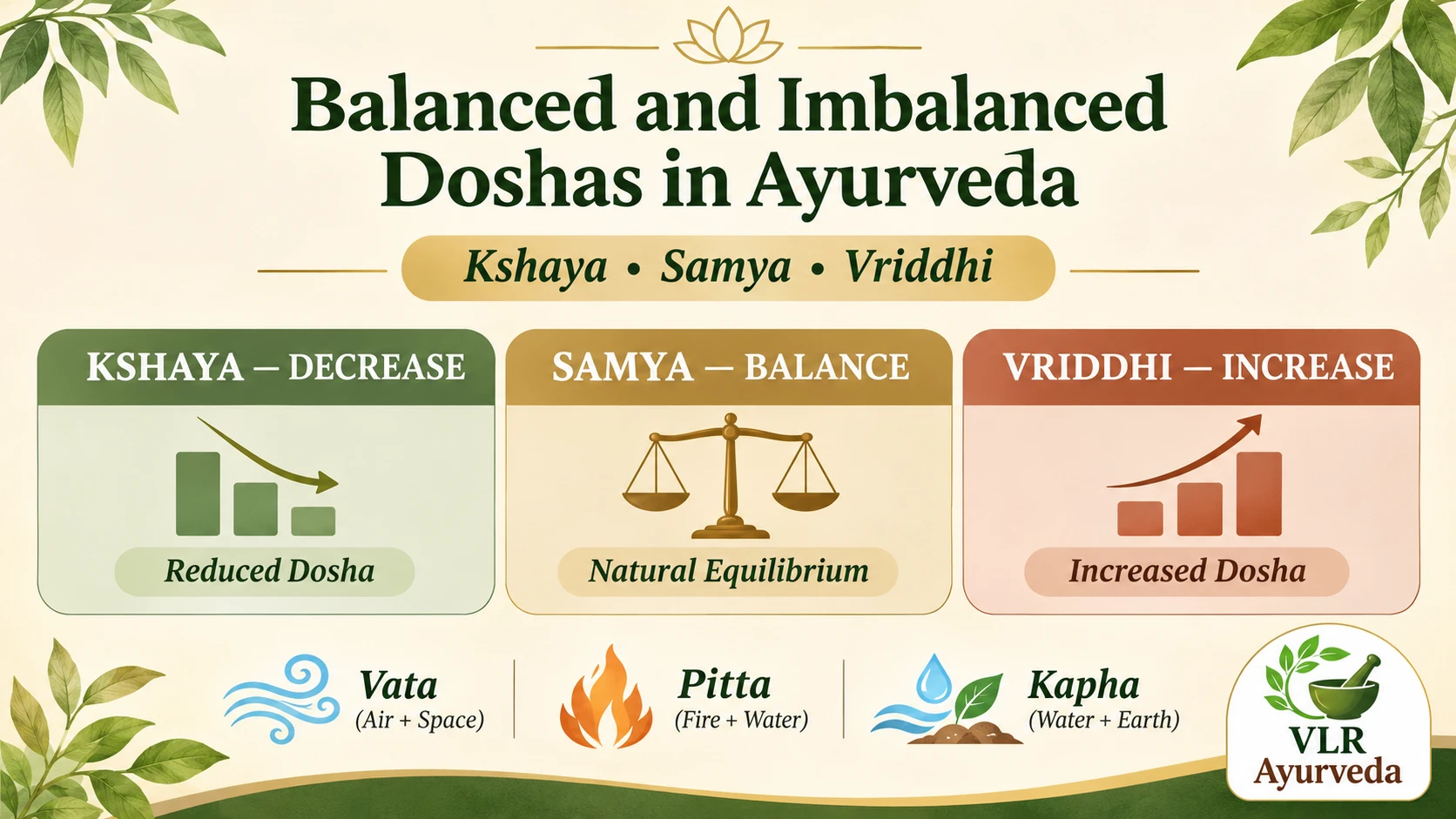
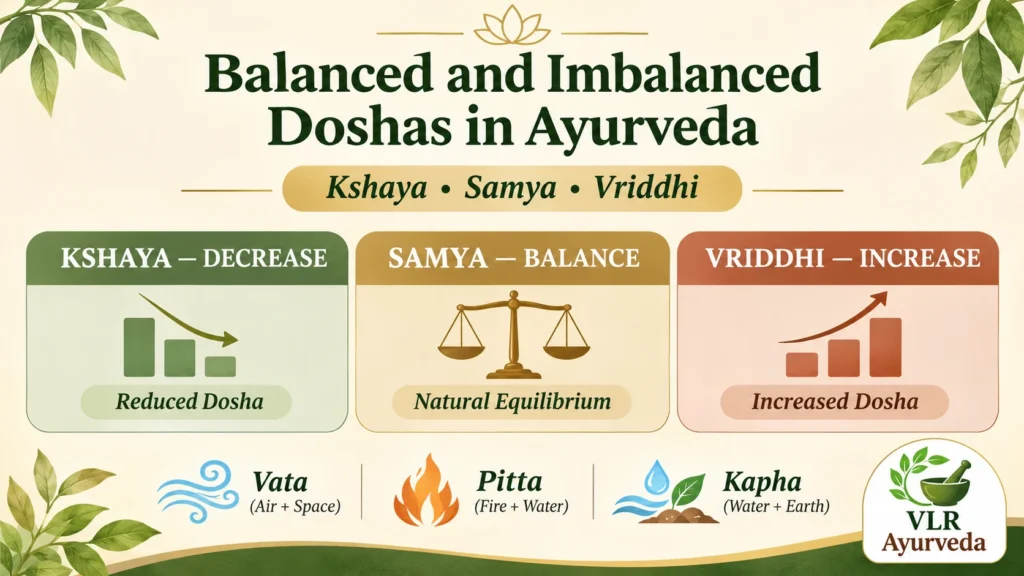
According to Ayurvedic principles, the three doshas can exist in three principal states.
These states are:
- Dosha Kshaya – Decreased state of dosha.
- Dosha Samya or Sthana – Balanced or normal state of dosha.
- Dosha Vriddhi – Increased state of dosha.
The classical Ayurvedic text Charaka Samhita describes these three states as Kshaya, Sthana and Vriddhi.
The general principle is that increased doshas manifest their characteristic signs, decreased doshas lose their normal signs or functions, and balanced doshas perform their normal activities.
This principle is discussed in Charaka Samhita, Sutrasthana, Chapter 17. Vedic Samhita+1
Comparison of the Three Dosha States
| Dosha State | Sanskrit Term | Meaning | General Significance |
|---|---|---|---|
| Decreased state | Dosha Kshaya | Reduction or depletion | Normal functions become reduced |
| Balanced state | Dosha Samya / Sthana | Equilibrium or normalcy | Normal physiological functions |
| Increased state | Dosha Vriddhi | Increase or aggravation | May produce disturbances and disease |
These three states help explain the relationship between doshic balance, normal body functions and disease manifestation.
4. Dosha Kshaya – Decreased State of Dosha
4.1 Definition of Dosha Kshaya
Dosha Kshaya (दोष क्षय) refers to a decreased or diminished state of any one of the three doshas.
The Sanskrit word Kshaya means reduction, depletion or diminution.
When a dosha decreases from its appropriate state, its characteristic qualities and normal functions may become diminished.
According to Ayurveda, Dosha Kshaya may occur in two important ways:
- Qualitative decrease: Reduction in the characteristic qualities (Gunas) of a particular dosha.
- Quantitative decrease: Reduction in the amount or overall presence of the dosha.
A diminished dosha may not perform its normal physiological functions effectively.
For example, when Kapha decreases, its characteristic properties, such as oiliness, lubrication and stability, may become reduced.
4.2 Characteristics of Dosha Kshaya
The important characteristics of Dosha Kshaya include:
- Reduction in the characteristic qualities of a dosha.
- Diminished expression of its normal functions.
- Disturbance in the relationship between the three doshas.
- Possibility of an increase in another dosha with opposing qualities.
- Changes in the body’s normal functional equilibrium.
According to the classical Ayurvedic framework, a decreased dosha is recognized by the reduction or disappearance of its characteristic signs.
4.3 Effect of Decreased Dosha on Other Doshas
One important Ayurvedic principle is that a decrease in one dosha may create conditions that favour an increase in another dosha.
This is particularly relevant when two doshas possess opposing qualities.
When the qualities of one dosha become reduced, the opposing dosha may become relatively more prominent.
Example: Decrease of Kapha and Increase of Vata
Kapha possesses qualities such as:
- Snigdha – Unctuousness or oiliness.
- Guru – Heaviness.
- Manda – Slowness.
- Sthira – Stability.
- Picchila – Sliminess or stickiness.
When Kapha decreases, its characteristic qualities, particularly oiliness and lubrication, may become reduced.
Vata, on the other hand, possesses qualities such as dryness, lightness and mobility.
Therefore, reduced Kapha qualities may create conditions in which Vata becomes relatively increased.
For example:
- Reduced Kapha may indicate decreased lubrication.
- Reduced lubrication is associated with increased dryness.
- Dryness is a characteristic quality of Vata.
- Consequently, Vata may become aggravated in the Ayurvedic interpretation.
This example demonstrates how an imbalance in one dosha may influence the equilibrium of the other doshas.
4.4 Does Dosha Kshaya Cause Disease?
In the classical framework described here, an isolated decrease of a dosha primarily results in diminished expression of its normal functions.
However, Dosha Kshaya may become clinically significant when it occurs together with an increase in another dosha.
For example, decreased Kapha accompanied by increased Vata may produce a combination of disturbances associated with both doshas.
Therefore, it is important to examine the overall condition of all three doshas rather than considering one dosha independently.
The classical Ayurvedic understanding also recognizes different combinations of increased and decreased doshas.
5. Dosha Samya – Balanced or Normal State of Dosha
5.1 Definition of Dosha Samya
Dosha Samya (दोष साम्य) refers to the normal and balanced state of Vata, Pitta and Kapha.
It is also described as the Sama Avastha, meaning the state of equilibrium.
The term Sthana is also used in the classical classification of the three dosha states to describe normalcy.
When all three doshas remain in their appropriate state, they perform their physiological functions effectively.
This balanced condition supports normal bodily activities and contributes to overall health.
5.2 Characteristics of Dosha Samya
The important characteristics of Dosha Samya include:
- Normal functioning of Vata, Pitta and Kapha.
- Appropriate expression of the characteristic qualities of each dosha.
- Maintenance of physiological activities.
- Proper coordination between the three doshas.
- Preservation of the body’s functional equilibrium.
- Support for physical and mental well-being.
5.3 Importance of Balanced Doshas in Maintaining Health
According to Ayurveda, the balanced state of the doshas is one of the essential foundations of health.
When the doshas remain balanced:
- Vata performs its normal movement-related activities.
- Pitta supports digestion and metabolic transformation.
- Kapha maintains stability, lubrication and structural support.
- The physiological functions of the body remain coordinated.
- The individual experiences better functional harmony.
However, classical Ayurveda describes health more comprehensively than dosha balance alone.
The condition of Agni (digestive and metabolic capacity), Dhatus (body tissues), Malas (waste products), sensory organs, mind and overall well-being is also considered important.
5.4 How to Maintain Dosha Samya
Maintaining doshic equilibrium requires appropriate dietary habits and a disciplined lifestyle.
Important traditional practices include:
1. Balanced Diet (Ahara)
- Consume suitable food according to individual constitution.
- Follow appropriate food habits.
- Avoid excessive consumption of unsuitable foods.
- Maintain regular meal timings.
- Consider seasonal dietary requirements.
2. Disciplined Lifestyle (Vihara)
- Follow a regular daily routine.
- Maintain appropriate sleeping habits.
- Include suitable physical activities.
- Avoid excessive physical and mental exertion.
- Adapt lifestyle practices according to seasonal changes.
3. Seasonal Adaptation (Ritucharya)
Ayurveda gives importance to adapting diet and lifestyle according to seasonal variations.
These adjustments are traditionally intended to help maintain equilibrium when environmental conditions change.
4. Individualized Health Management
Diet and lifestyle should be selected according to individual Prakriti, present health status, digestive capacity and environmental conditions.
The objective is to maintain the appropriate functional state of Vata, Pitta and Kapha.
6. Dosha Vriddhi – Increased State of Dosha
6.1 Definition of Dosha Vriddhi
Dosha Vriddhi (दोष वृद्धि) refers to an increased or aggravated state of any one of the three doshas.
The Sanskrit word Vriddhi means increase, growth or augmentation.
When a dosha increases beyond its appropriate state, its characteristic qualities and functions may become excessive.
This may interfere with the normal functioning of the body and contribute to the manifestation of disease.
Dosha Vriddhi is considered particularly important in Ayurvedic disease management because increased doshas can produce pathological disturbances.
6.2 Types of Dosha Vriddhi
The increase of dosha may be understood in three ways.
1. Qualitative Increase
Qualitative increase refers to an enhancement of the characteristic qualities (Gunas) of a dosha.
For example, an increase in the Ruksha (dry) quality is associated with the qualities of Vata.
2. Quantitative Increase
Quantitative increase refers to an increase in the overall presence or measure of a particular dosha.
3. Functional Increase
Functional increase refers to excessive activity or expression of the functions associated with a dosha.
These forms of increase may occur individually or in combination.
6.3 Characteristics of Dosha Vriddhi
Important characteristics include:
- Excessive expression of the qualities of a dosha.
- Increased activity of its associated functions.
- Disturbance in normal physiological activities.
- Possibility of interactions with other doshas.
- Potential disturbance of body tissues (Dhatus).
- Increased possibility of disease manifestation when the imbalance progresses.
6.4 How Does Increased Dosha Affect the Body?
According to Ayurveda, an increased dosha may produce its characteristic signs and symptoms depending on the degree of aggravation.
For example, increased Vata may express excessive dryness, lightness or movement-related disturbances in the traditional Ayurvedic framework.
Similarly, increased Pitta may express excessive heat-related and transformation-related qualities, while increased Kapha may express excessive heaviness, stability or lubrication.
When the increased dosha is not appropriately managed, it may disturb the normal activities of the body.
However, every increase does not immediately produce a disease.
Sometimes, an increased dosha may initially cause relatively mild functional disturbances. If the imbalance persists or progresses, more significant pathological manifestations may develop.
6.5 Importance of Early Management of Dosha Vriddhi
Early recognition of an aggravated dosha is important in traditional Ayurvedic management.
The objective is to restore the dosha to its appropriate state before the disturbance progresses.
Ayurvedic management may involve:
- Appropriate dietary modifications.
- Lifestyle adjustments.
- Suitable medicines prescribed by a qualified practitioner.
- Specific therapeutic procedures when indicated.
- Regular assessment of the individual’s health condition.
The treatment approach depends on the dosha involved, its degree of aggravation, the individual’s constitution and the overall clinical condition.
7. Causes of Dosha Imbalance in Ayurveda
Several internal and external factors may influence the normal state of Vata, Pitta and Kapha.
The major factors discussed in Ayurveda include diet, lifestyle, environmental conditions and natural variations.
7.1 Dietary Factors (Ahara)
Food plays an important role in maintaining or disturbing the balance of the three doshas.
Inappropriate food habits may contribute to doshic disturbances.
Examples include:
- Excessive consumption of unsuitable foods.
- Irregular eating habits.
- Consuming food that is inappropriate for an individual’s constitution.
- Failure to adapt dietary habits to seasonal changes.
- Excessive consumption of foods with particular qualities.
7.2 Lifestyle Factors (Vihara)
Lifestyle habits also influence doshic balance.
Examples include:
- Irregular sleeping patterns.
- Excessive physical activity.
- Insufficient rest.
- Improper daily routines.
- Activities that are unsuitable for an individual’s constitution.
7.3 Seasonal Factors (Ritu)
Changes in environmental conditions and seasons may influence the state of the doshas.
Ayurveda describes seasonal patterns of doshic accumulation, aggravation and pacification.
These natural variations are part of the traditional understanding of the body’s relationship with the environment.
Importantly, normal seasonal variation is not automatically a pathological imbalance.
7.4 Time-Related Factors (Kala)
Ayurveda also considers time-related influences in understanding doshic activities.
Different times of the day and seasonal periods are associated with characteristic doshic patterns.
These variations are considered when planning appropriate daily routines and lifestyle practices.
8. Difference Between Dosha Kshaya, Dosha Samya and Dosha Vriddhi
Understanding the differences between the three states is essential for learning Ayurvedic principles of health and disease.
| Feature | Dosha Kshaya | Dosha Samya | Dosha Vriddhi |
|---|---|---|---|
| Meaning | Decrease | Balance | Increase |
| State | Diminished | Normal | Aggravated |
| Dosha qualities | Reduced | Appropriately expressed | Excessively expressed |
| Normal functions | May decrease | Performed normally | May become excessive or disturbed |
| Physiological effect | Functional deficiency | Functional equilibrium | Functional disturbance |
| Disease significance | May contribute to combined imbalance | Does not produce disturbance by itself | May contribute to disease manifestation |
| Traditional management | Nourishing or increasing the diminished qualities | Maintaining equilibrium | Reducing or pacifying the increased dosha |
9. How to Balance Decreased and Increased Doshas
Ayurveda emphasizes restoring the appropriate state of the doshas through suitable diet, lifestyle and therapeutic approaches.
The approach differs depending on whether the dosha is decreased or increased.
9.1 Management of Dosha Kshaya
When a dosha is decreased, the traditional approach is to support and restore the diminished dosha.
Ayurveda uses the principle of Samanya, which indicates that substances possessing similar qualities tend to increase similar qualities.
Accordingly, food and activities with qualities similar to those of the decreased dosha may be considered to help restore its normal state.
Example: Management of Decreased Kapha
When Kapha is decreased, its characteristic properties, such as oiliness and lubrication, may also become reduced.
The traditional approach may include:
- Appropriate unctuous or nourishing foods.
- Suitable rest.
- Activities that support Kapha-related qualities.
- A dietary and lifestyle routine selected according to individual requirements.
Daytime sleep is traditionally described as a Kapha-increasing influence. However, it is not suitable for everyone and may aggravate Kapha-related conditions in other circumstances.
Therefore, these measures should not be adopted without considering the individual’s constitution and health condition.
The objective is to bring the decreased dosha towards its appropriate state rather than producing excessive increase.
9.2 Management of Dosha Vriddhi
When a dosha becomes increased, the objective is to reduce or pacify its excessive qualities.
Ayurveda applies the principle of Vishesha, which explains that substances and measures with opposing qualities tend to reduce the corresponding excessive qualities.
For example:
- Excessive dryness may be addressed using appropriate unctuous measures in Vata-related management.
- Excessive heat-related qualities may be addressed using appropriate cooling measures in Pitta-related management.
- Excessive heaviness may be addressed using suitable lightening measures in Kapha-related management.
The actual treatment must be individualized.
Traditional Treatment Approaches
The management of increased dosha may include:
1. Dietary Management
Selecting appropriate foods to reduce the excessive qualities of the aggravated dosha.
2. Lifestyle Management
Adopting activities and daily routines that help restore doshic equilibrium.
3. Ayurvedic Medicines
Appropriate medicines may be prescribed based on the condition and individual assessment.
4. Panchakarma Procedures
In selected cases, specific Panchakarma procedures may be considered by qualified Ayurvedic practitioners.
The selection of treatment depends on the nature and severity of the imbalance.
Panchakarma should not be considered a universal treatment for every increased dosha. It requires appropriate assessment, preparation, supervision and aftercare.
9.3 Management of Dosha Samya
When all three doshas are in their appropriate state, the primary objective is to preserve their equilibrium.
This can be supported through:
- Balanced dietary habits.
- A disciplined daily routine.
- Suitable physical activities.
- Appropriate sleeping patterns.
- Seasonal adjustments.
- Avoidance of excessive or unsuitable habits.
Maintaining balance is generally preferable to waiting until significant disturbances develop.
10. Practical Examples of the Three Dosha States
The following examples help illustrate the three states in everyday Ayurvedic learning.
Example 1: Kapha Kshaya
A decrease in Kapha is traditionally associated with reduced oiliness and lubrication.
In this condition, the diminished qualities of Kapha may require appropriate nourishing and unctuous measures.
Example 2: Dosha Samya
When Vata, Pitta and Kapha remain in their appropriate functional states, they support normal bodily activities.
Such a condition represents Dosha Samya.
Example 3: Vata Vriddhi
When Vata becomes increased, its characteristic qualities, such as dryness, lightness and excessive movement, may become more prominent.
Appropriate Vata-pacifying measures may be considered according to individual assessment.
These examples demonstrate why the identification of the particular dosha state is important before selecting dietary or therapeutic measures.
11. Importance of Understanding Dosha Imbalance in Ayurveda
Knowledge of Dosha Kshaya, Dosha Samya and Dosha Vriddhi is essential for understanding the basic principles of Ayurvedic physiology and pathology.
This classification helps in several ways.
1. Understanding Health
Dosha Samya provides the foundation for understanding the balanced state of the three doshas.
2. Understanding Disease
Dosha Vriddhi explains how excessive expression of doshic qualities may contribute to functional disturbances and disease manifestation.
3. Identifying Functional Decrease
Dosha Kshaya helps explain the reduced expression of normal doshic functions.
4. Understanding Interactions Between Doshas
The increase or decrease of one dosha may influence the condition of the other doshas.
5. Selecting Appropriate Management
The three states help guide the traditional selection of dietary, lifestyle and therapeutic approaches.
6. Individualized Health Management
Understanding an individual’s Prakriti and present doshic condition helps formulate appropriate Ayurvedic management strategies.
For students following VLR Ayurveda educational materials, understanding these three states provides an important foundation for studying Ayurvedic diagnosis and treatment principles.
12. Ayurvedic Principles Behind Dosha Balance
Two important principles help explain the traditional approach to maintaining doshic equilibrium.
12.1 Samanya Siddhanta
Samanya means similarity or commonality.
According to this principle, substances possessing similar qualities tend to increase similar qualities.
For example, substances with unctuous properties may support the increase of Kapha-related qualities.
This principle is traditionally applied when managing diminished doshic qualities.
12.2 Vishesha Siddhanta
Vishesha means differentiation or dissimilarity.
According to this principle, opposing qualities tend to reduce or counterbalance one another.
For example, excessive heaviness may be addressed through suitable lightening measures.
This principle is traditionally applied when managing increased doshic qualities.
Together, Samanya and Vishesha provide an important conceptual basis for understanding Ayurvedic dietary and therapeutic management.
13. Precautions and Safety Considerations ⚠️
Although dosha-balancing principles are important in Ayurvedic education, treatment should always be individualized.
The following precautions are important:
- Do not diagnose dosha imbalance based on a single symptom.
- Do not assume that every physical discomfort is caused by an increased or decreased dosha.
- Avoid following dietary restrictions without considering nutritional requirements.
- Do not use Ayurvedic medicines without appropriate professional guidance.
- Panchakarma procedures should be performed only under qualified supervision.
- Inform healthcare professionals about all medicines and herbal products being used.
- Do not discontinue prescribed modern medicines without consulting the prescribing clinician.
- Seek timely medical assessment for persistent, severe or worsening symptoms.
Scientific evidence for Ayurvedic interventions varies by treatment and health condition. The US National Center for Complementary and Integrative Health (NCCIH) notes that many studies are small or inadequately designed. It also warns that some Ayurvedic preparations may contain potentially toxic amounts of lead, mercury or arsenic.
Readers can refer to the NCCIH guide to Ayurvedic Medicine for further information about research evidence and safety. NCCIH
Traditional Ayurvedic concepts should be understood within their original framework and should not automatically be treated as equivalent to modern biomedical measurements or diagnoses.
14. Important Points to Remember
The following points summarize the essential principles of doshic balance.
- Vata, Pitta and Kapha are the three fundamental doshas in Ayurveda.
- Dosha Samya represents the balanced state of the three doshas.
- Dosha Kshaya represents the decreased or diminished state of a dosha.
- Dosha Vriddhi represents the increased or aggravated state of a dosha.
- Dosha Kshaya may result in reduced expression of normal functions.
- A decrease in one dosha may influence the state of another dosha.
- Increased doshas may disturb normal bodily functions and contribute to disease.
- Diet, lifestyle and environmental conditions influence doshic balance.
- Similar qualities are traditionally used to support a diminished dosha.
- Opposing qualities are traditionally used to pacify an increased dosha.
- Maintaining Dosha Samya is an important objective of Ayurvedic health management.
- All treatment approaches must be selected according to individual requirements.
15. Summary
Ayurveda describes three important states of the Tridosha system: Dosha Kshaya, Dosha Samya and Dosha Vriddhi.
Dosha Kshaya represents a decrease in the qualities and functions of a dosha. Dosha Samya represents the normal and balanced condition in which the doshas perform their physiological activities appropriately. Dosha Vriddhi represents an increase or aggravation that may disturb normal bodily functions and contribute to disease.
The three states are interconnected because changes in one dosha may influence the functioning of the other doshas.
Ayurvedic principles use appropriate diet, lifestyle modifications and individualized therapeutic approaches to restore and maintain equilibrium.
The central educational message of VLR Ayurveda is that understanding the balanced, decreased and increased states of Vata, Pitta and Kapha is essential for understanding Ayurvedic physiology, pathology and the principles of disease management.
Maintaining doshic equilibrium is therefore an important part of preserving health according to traditional Ayurvedic principles.
16. Frequently Asked Questions (FAQs)
1. What are the three states of Dosha in Ayurveda?
The three states are:
- Dosha Kshaya – Decreased state.
- Dosha Samya – Balanced or normal state.
- Dosha Vriddhi – Increased or aggravated state.
2. What is Dosha Samya?
Dosha Samya refers to the balanced state of Vata, Pitta and Kapha in which they perform their normal physiological functions.
3. What is Dosha Kshaya?
Dosha Kshaya means a decrease or reduction in the qualities and functions of one of the three doshas.
4. What is Dosha Vriddhi?
Dosha Vriddhi means an increase or aggravation of Vata, Pitta or Kapha beyond its appropriate state.
5. Can a decrease in one dosha increase another dosha?
According to Ayurvedic principles, a decrease in one dosha may favour the increase of another dosha, particularly when their characteristic qualities are opposing.
For example, decreased Kapha may be associated with increased Vata because of the reduction in Kapha-related lubrication and oiliness.
6. Does Dosha Kshaya always cause disease?
An isolated decrease of a dosha is traditionally understood mainly as a reduction in its normal functions. However, combined disturbances involving other increased doshas may produce significant health disturbances.
7. What are the main causes of Dosha Vriddhi?
Important influencing factors include:
- Inappropriate dietary habits.
- Unsuitable lifestyle practices.
- Seasonal variations.
- Time-related influences.
- Activities that increase the characteristic qualities of a particular dosha.
8. How can decreased dosha be balanced?
Traditional Ayurvedic management uses appropriate foods and activities possessing qualities similar to those of the decreased dosha. The approach should be individualized.
9. How can increased dosha be balanced?
Increased doshas are traditionally managed using suitable opposing qualities, dietary modifications, lifestyle changes and, when indicated, practitioner-supervised Ayurvedic therapies.
10. What is the importance of maintaining Dosha Samya?
Dosha Samya supports the normal functioning of Vata, Pitta and Kapha and represents an important principle of maintaining health according to Ayurveda.
References and Further Reading
1. Classical Ayurvedic Reference
Caraka Saṃhitā, Sūtrasthāna, Chapter 17 – Kiyantaḥśirasīya Adhyāya. Includes the classification of dosha decrease, normalcy and increase, and their combinations.
URL: https://www.vedicsamhita.in/ayurveda/caraka/1/17
2. Government of Andhra Pradesh – Department of Health and Family Welfare
AYUSH – Overview of Ayurveda, Tridosha theory, Panchamahabhuta and the holistic understanding of health.
URL: https://hmfw.ap.gov.in/ayush-org.aspx
3. National Center for Complementary and Integrative Health (NCCIH), USA
Ayurvedic Medicine: In Depth – Research evidence, effectiveness and safety considerations relating to Ayurvedic medicine.
URL: https://www.nccih.nih.gov/health/ayurvedic-medicine-in-depth
Content category: Ayurveda – Fundamental Principles (Ayurveda Samhita and Siddhanta)
Suggested website tags: Tridosha, Dosha Samya, Dosha Kshaya, Dosha Vriddhi, Vata Pitta Kapha, Ayurveda Health Principles, Ayurvedic Lifestyle, Panchakarma, Ayurveda Education.
The next useful article in this learning series would be “Causes and Symptoms of Vata, Pitta and Kapha Imbalance in Ayurveda”, continuing from the three dosha states explained here.