Tridosha in Ayurveda: Vata, Pitta, Kapha | VLR Ayurveda
🌿 Tridosha in Ayurveda – Vata, Pitta, Kapha, Prakriti, Functions, Characteristics and Locations
🌿 1. Introduction to Tridosha in Ayurveda
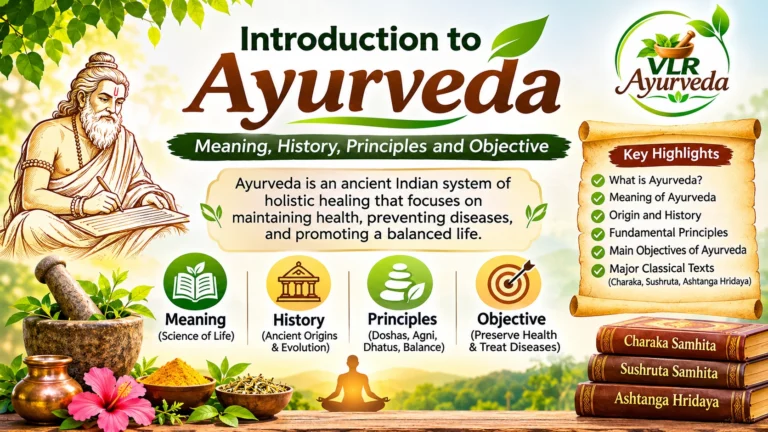
Tridosha is one of the fundamental concepts of Ayurveda. According to Ayurvedic principles, the human body and mind are governed by three functional principles known as Doshas.
The three Doshas are:
- 🌬️ Vata Dosha
- 🔥 Pitta Dosha
- 💧 Kapha Dosha
These three Doshas play important roles in maintaining the body’s physiological activities, structural stability, digestion, metabolism and movement.
According to Ayurveda, health is associated with the balanced functioning of these three Doshas. When they become aggravated or imbalanced, they may contribute to disturbances in bodily functions and the development of diseases.
Every individual has a unique combination of Vata, Pitta and Kapha. This individual combination is known as Prakriti, which represents a person’s natural body and mind constitution.
Understanding Tridosha is important because it provides the foundation for understanding individual differences, dietary requirements, lifestyle practices and the Ayurvedic approach to maintaining health.
📖 2. What Are Doshas in Ayurveda?
The Sanskrit word Dosha refers to principles that can become disturbed or aggravated and contribute to changes in the body’s functioning.
In Ayurveda, Doshas are described as three fundamental biological regulatory principles that influence the physical and psychological activities of an individual.
The three Doshas perform different primary functions:
- 🌬️ Vata: Responsible for movement and communication.
- 🔥 Pitta: Responsible for digestion, transformation and metabolism.
- 💧 Kapha: Responsible for stability, structure, support and lubrication.
These three principles work together to maintain the normal functioning of the body.
⭐ Important Characteristics of Doshas
- Doshas are present throughout the human body.
- Each Dosha has its own principal functions.
- Each Dosha has specific characteristics and qualities.
- Every individual has a unique combination of the three Doshas.
- Dosha balance is an important concept in Ayurvedic health.
- Ayurvedic treatment approaches consider the individual’s constitution and current Dosha condition.
🖐️ 3. Relationship Between Panchamahabhuta and Tridosha
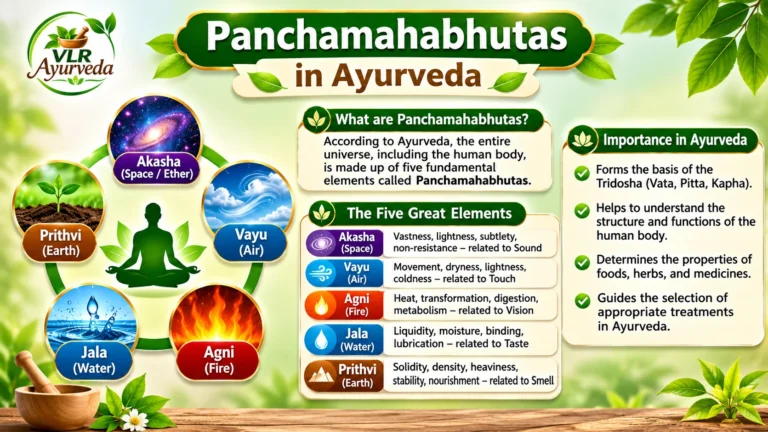
To understand the three Doshas, it is important to understand the concept of Panchamahabhuta.
According to Ayurveda, the universe and the human body are understood through five fundamental elements.
These five elements are called Panchamahabhutas.
🌱 Five Elements of Panchamahabhuta
| Sanskrit Name | English Name | General Characteristics |
|---|---|---|
| Akasha Mahabhuta | Space / Ether | Space, openness and expansion |
| Vayu Mahabhuta | Air | Movement and mobility |
| Agni Mahabhuta | Fire | Heat and transformation |
| Jala Mahabhuta | Water | Fluidity and cohesion |
| Prithvi Mahabhuta | Earth | Solidity and stability |
These five elements form the conceptual foundation for understanding the three Doshas.
🔗 Combination of Five Elements to Form Three Doshas
| Dosha | First Element | Second Element |
|---|---|---|
| 🌬️ Vata | Akasha (Space) | Vayu (Air) |
| 🔥 Pitta | Agni (Fire) | Jala (Water) |
| 💧 Kapha | Jala (Water) | Prithvi (Earth) |
📌 Simple Explanation
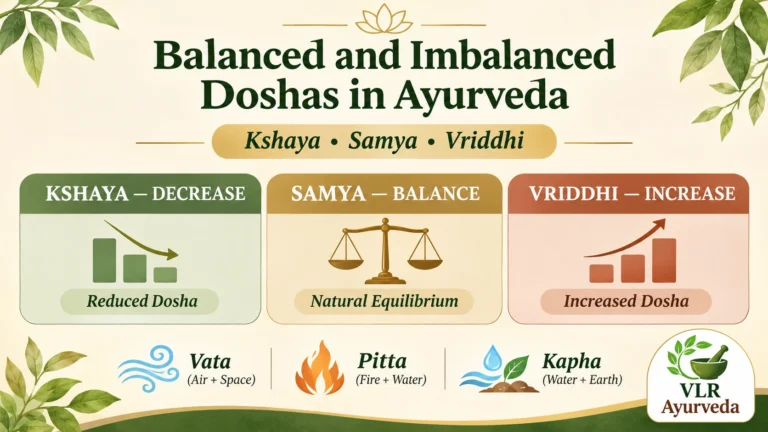
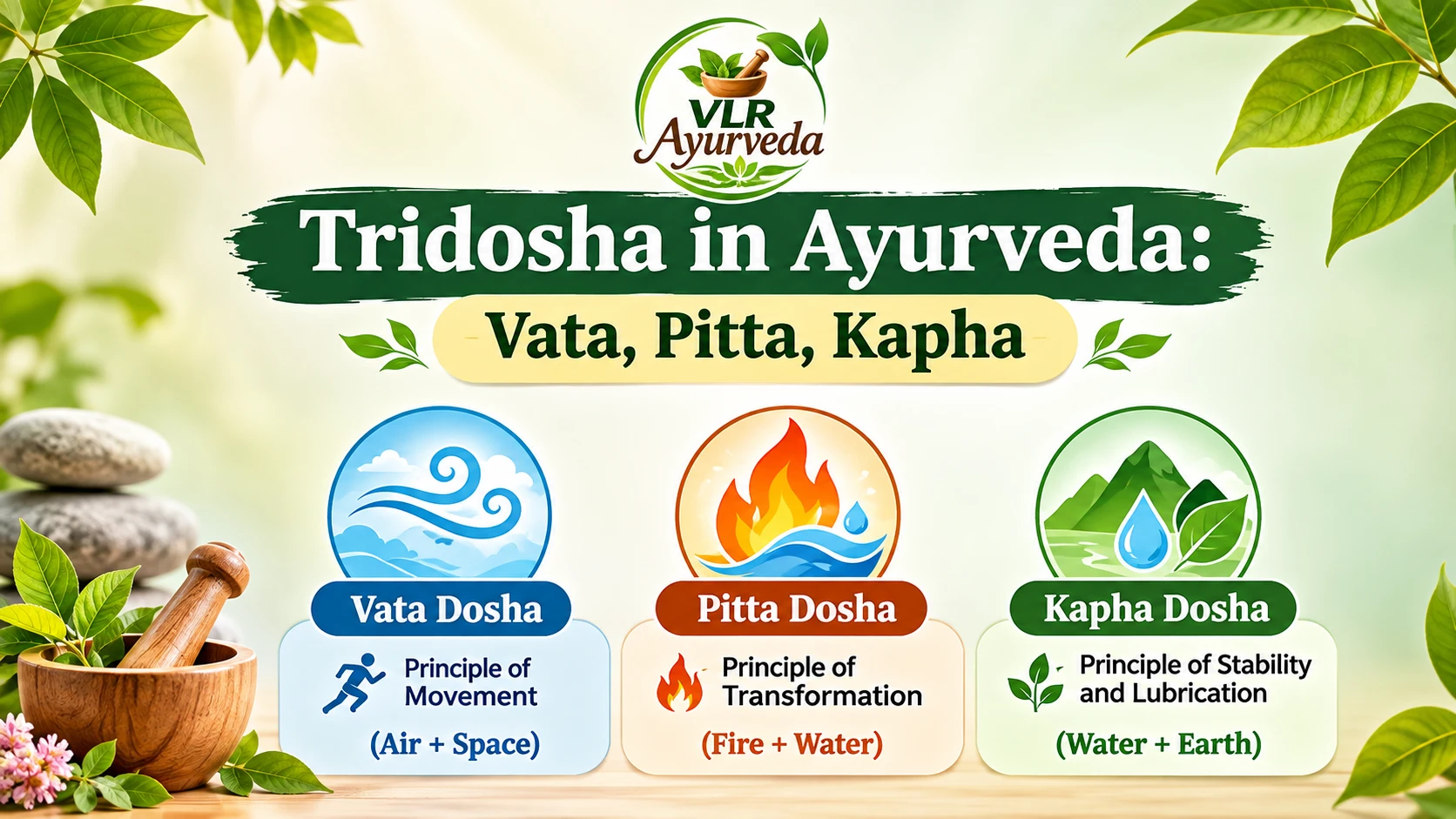
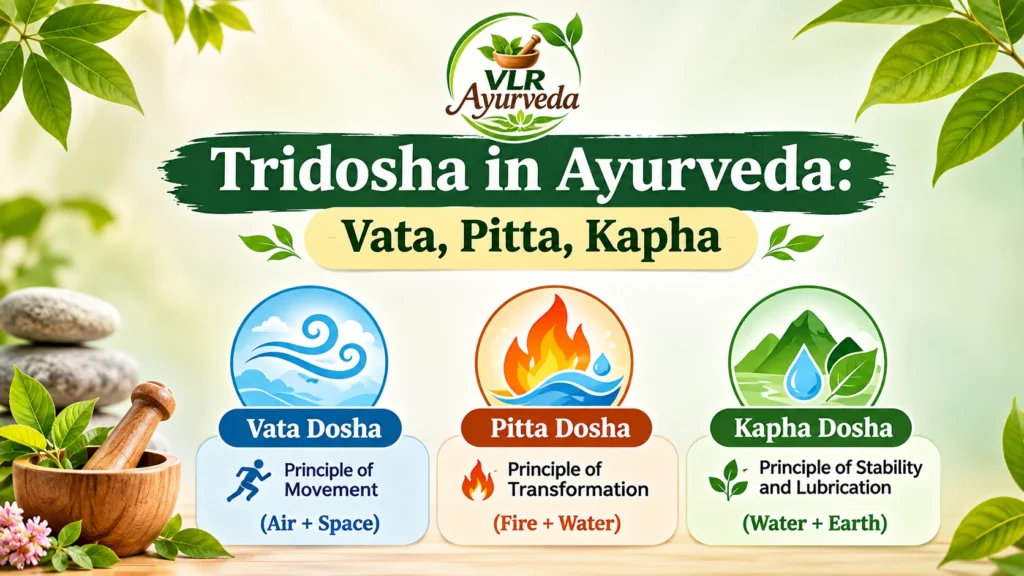
- 🌬️ Vata = Space + Air
- 🔥 Pitta = Fire + Water
- 💧 Kapha = Water + Earth
These combinations represent the traditional Ayurvedic relationship between Panchamahabhuta and Tridosha.
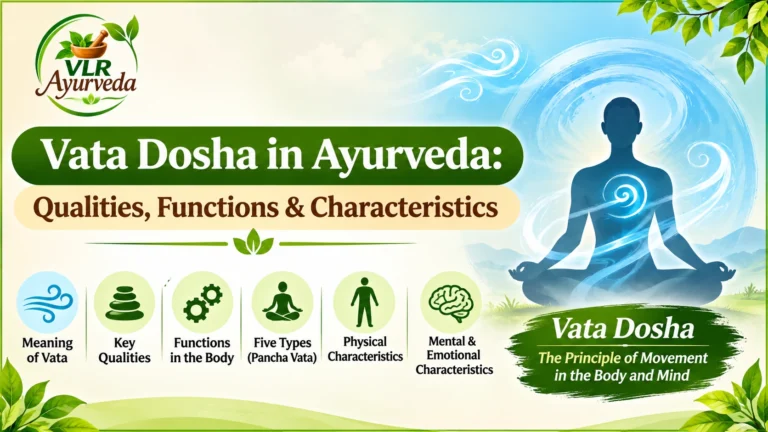
🌬️ 4. Vata Dosha – The Principle of Movement
4.1 🔍 What Is Vata Dosha?
Vata Dosha is formed by the combination of:
- Akasha Mahabhuta (Space)
- Vayu Mahabhuta (Air)
Vata represents the principle of movement and communication in the Ayurvedic understanding of the human body.
It governs different types of movements and activities that take place within the body.
The primary function of Vata Dosha is movement.
4.2 ⚙️ Main Functions of Vata Dosha
Vata is responsible for several important activities.
1. Body Movements
Vata governs the movements of different body parts.
Examples:
- Walking
- Running
- Moving hands and legs
- Bending and stretching
- Movement of joints
2. Breathing
According to Ayurveda, Vata plays an important role in the breathing process.
The movement associated with inhalation and exhalation is governed by Vata.
3. Nervous System Activities
Vata is traditionally associated with sensory and motor activities, communication and coordination.
4. Circulation and Internal Movement
The movement of different substances throughout the body is also associated with Vata.
5. Elimination
Vata governs the movements involved in eliminating waste materials from the body.
6. Speech and Communication
Vata is associated with speech, voice production and other communicative activities.
4.3 ⭐ Characteristics of Vata Dosha
The predominant Vata qualities are:
- Dryness
- Lightness
- Coldness
- Mobility
- Roughness
- Subtlety
- Irregularity
4.4 👤 Physical Characteristics of Vata Individuals
A person with predominant Vata Prakriti may commonly demonstrate:
- Lean or slender body structure.
- Relatively low body weight.
- Dry skin.
- Cold hands and feet.
- Variable appetite.
- Irregular sleep patterns.
- Quick movements.
- A tendency towards physical restlessness.
4.5 🧠 Mental Characteristics of Vata Individuals
Some commonly described mental tendencies include:
- Quick thinking.
- Creative imagination.
- Enthusiasm.
- Fast learning when interested.
- Frequent changes in thoughts.
- Adaptability.
- Difficulty maintaining concentration in some situations.
4.6 💡 Example of Vata Dosha
Consider two individuals performing the same physical activity.
The first individual walks quickly, speaks quickly and completes tasks rapidly.
The second individual moves more slowly and prefers a relaxed working style.
Within the Ayurvedic framework, movement-related differences may be understood partly through the influence of Vata.
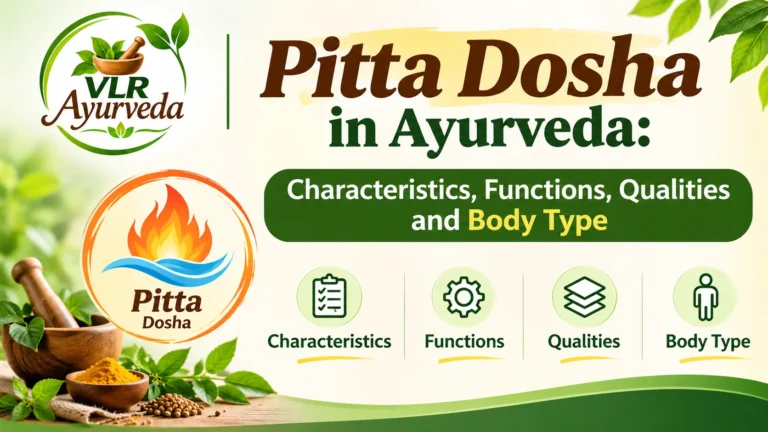
🔥 5. Pitta Dosha – The Principle of Transformation
5.1 🔍 What Is Pitta Dosha?
Pitta Dosha is formed by the combination of:
- Agni Mahabhuta (Fire)
- Jala Mahabhuta (Water)
Pitta represents the principle of transformation and heat in the human body according to Ayurveda.
It is primarily responsible for digestion, metabolism and various transformative processes.
The main function of Pitta Dosha is transformation.
5.2 ⚙️ Main Functions of Pitta Dosha
1. Digestion
Pitta plays an important role in the digestion of food.
The digestive process transforms the food we consume into substances that can be utilized by the body.
2. Metabolism
Pitta is associated with metabolic activities.
It represents the processes through which the body transforms and utilizes nutrients.
3. Body Temperature
Pitta is associated with heat production and maintaining the body’s internal warmth.
4. Transformation of Nutrients
The transformation and processing of nutrients are associated with Pitta.
5. Vision
Ayurvedic descriptions also associate Pitta with visual functions.
6. Skin and Colour
Pitta is traditionally associated with complexion, skin characteristics and certain processes related to pigmentation.
5.3 ⭐ Characteristics of Pitta Dosha
Some important qualities of Pitta include:
- Heat
- Sharpness
- Lightness
- Fluidity
- Slight oiliness
- Intensity
- Spreading nature
5.4 👤 Physical Characteristics of Pitta Individuals
People with predominant Pitta Prakriti may commonly demonstrate:
- Moderate body structure.
- Relatively warm body temperature.
- Warm or oily skin.
- Strong appetite.
- Regular digestion.
- A tendency to feel uncomfortable in excessive heat.
- A tendency towards excessive sweating.
5.5 🧠 Mental Characteristics of Pitta Individuals
Commonly described mental characteristics include:
- Intelligence.
- Sharp understanding.
- Good decision-making ability.
- Strong determination.
- Leadership qualities.
- Organized thinking.
- Competitive nature.
- A tendency towards irritability or quick temper when aggravated.
5.6 💡 Example of Pitta Dosha
Consider two individuals having the same meal.
One person can digest the meal comfortably and feels hungry again after a few hours.
Another person experiences slower digestion and does not feel hungry for a long time.
In Ayurveda, differences in digestive functioning are understood partly through the condition of Pitta and Agni.
💧 6. Kapha Dosha – The Principle of Stability and Structure
6.1 🔍 What Is Kapha Dosha?
Kapha Dosha is formed by the combination of:
- Jala Mahabhuta (Water)
- Prithvi Mahabhuta (Earth)
Kapha represents the principles of structure, stability, nourishment, support and lubrication in Ayurveda.
The primary function of Kapha Dosha is stability and lubrication.
It provides structural support and helps maintain the cohesion of different tissues.
6.2 ⚙️ Main Functions of Kapha Dosha
1. Structural Support
Kapha is associated with the structural foundation of the body.
It contributes to the formation and maintenance of body tissues.
2. Stability
Kapha helps maintain physical stability and strength.
3. Lubrication
It is associated with lubrication in the joints and tissues.
This helps maintain smooth movement and prevents excessive dryness.
4. Nourishment
Kapha is traditionally associated with nourishing and maintaining body tissues.
5. Strength and Endurance
Kapha is associated with physical endurance, strength and sustained energy.
6. Protection
Kapha is linked with protective and supportive functions within the body.
6.3 ⭐ Characteristics of Kapha Dosha
The important qualities of Kapha include:
- Heaviness
- Stability
- Coldness
- Smoothness
- Oiliness
- Slowness
- Solidity
- Softness
6.4 👤 Physical Characteristics of Kapha Individuals
A person with predominant Kapha Prakriti may commonly demonstrate:
- Solid or well-built body structure.
- A tendency towards higher body weight.
- Smooth skin.
- Strong physical endurance.
- Stable energy levels.
- Thick hair.
- Slower movements.
- Deep or prolonged sleep.
6.5 🧠 Mental Characteristics of Kapha Individuals
Commonly described mental characteristics include:
- Calm temperament.
- Patience.
- Emotional stability.
- Good memory retention.
- Consistency.
- Reliability.
- Affectionate nature.
- A tendency towards slow decision-making or attachment when Kapha is aggravated.
6.6 💡 Example of Kapha Dosha
Consider two individuals participating in a physical activity.
One individual prefers fast movements and changes activities frequently.
Another individual prefers a steady pace and continues the same activity consistently for a longer period.
Within the Ayurvedic framework, these differences may be discussed in relation to the movement and stability characteristics of Vata and Kapha.
📊 7. Comparison Between Vata, Pitta and Kapha Doshas
The three Doshas have different elemental compositions, characteristics and functions.
The following table summarizes their major differences.
| Characteristics | 🌬️ Vata | 🔥 Pitta | 💧 Kapha |
|---|---|---|---|
| Elements | Air + Space | Fire + Water | Water + Earth |
| Main Function | Movement | Transformation | Stability |
| Primary Quality | Mobility | Heat | Heaviness |
| Body Nature | Generally lean | Generally moderate | Generally solid |
| Skin | Often dry | Often warm or oily | Often smooth or oily |
| Digestion | Variable | Traditionally stronger | Traditionally slower |
| Temperament | Active and quick | Sharp and intense | Calm and steady |
| Energy | Variable | Intense | Enduring |
| Major Role | Movement | Digestion and metabolism | Support and lubrication |
🧠 Simple Way to Remember the Three Doshas
- 🌬️ Vata = Movement: Walking, breathing, circulation and body movements.
- 🔥 Pitta = Transformation: Digestion, metabolism and transformation.
- 💧 Kapha = Stability: Body structure, support and lubrication.
🧬 8. What Is Prakriti in Ayurveda?
Prakriti is one of the important concepts in Ayurvedic physiology.
Prakriti refers to the natural body and mind constitution of an individual.
Every person has a unique combination of Vata, Pitta and Kapha.
The relative predominance of these Doshas determines the individual’s constitutional characteristics within the Ayurvedic framework.
For example:
- One person may have predominant Vata.
- Another person may have predominant Pitta.
- Another person may have predominant Kapha.
- Some individuals may have a combination of two predominant Doshas.
- Some individuals may have a relatively balanced combination of all three Doshas.
Therefore, every individual does not necessarily belong to only one pure Dosha category.
8.1 ⭐ Why Is Prakriti Important?
Understanding Prakriti helps in understanding individual differences.
It is traditionally considered when assessing:
- Body constitution.
- Physical characteristics.
- Digestive tendencies.
- Mental and behavioural tendencies.
- Dietary suitability.
- Lifestyle requirements.
- Individual health tendencies.
Ayurvedic practitioners consider Prakriti along with other factors when planning personalized dietary, lifestyle and treatment approaches.
8.2 📋 Types of Prakriti
Prakriti can broadly be understood through seven constitutional classifications.
| Type | Description |
|---|---|
| Vata Prakriti | Vata is predominant |
| Pitta Prakriti | Pitta is predominant |
| Kapha Prakriti | Kapha is predominant |
| Vata-Pitta Prakriti | Vata and Pitta are predominant |
| Vata-Kapha Prakriti | Vata and Kapha are predominant |
| Pitta-Kapha Prakriti | Pitta and Kapha are predominant |
| Sama Prakriti | All three Doshas are relatively balanced |
8.3 💡 Practical Example of Prakriti
Consider three individuals.
👤 Person A:
- Lean body structure.
- Quick movements.
- Frequently changing appetite.
- Active thinking.
These characteristics may indicate Vata predominance.
👤 Person B:
- Moderate body structure.
- Strong appetite.
- Warm skin.
- Sharp thinking.
These characteristics may indicate Pitta predominance.
👤 Person C:
- Solid body structure.
- Calm temperament.
- Steady energy.
- Slow but consistent movements.
These characteristics may indicate Kapha predominance.
These examples illustrate traditional constitutional tendencies. A single physical or mental characteristic cannot establish a person’s Prakriti.
⚖️ 9. Difference Between Prakriti and Vikriti
Prakriti and Vikriti are two important concepts in understanding Dosha conditions.
| Prakriti | Vikriti |
|---|---|
| Natural body constitution | Current Dosha condition |
| Relatively stable throughout life | Can change over time |
| Established during conception and early development | Influenced by diet, lifestyle, environment, seasons and other factors |
| Represents an individual’s constitutional tendencies | Represents the present state of Dosha imbalance or disturbance |
| Helps understand individual differences | Helps understand current health disturbances |
💡 Practical Example
A person may naturally have Pitta-dominant Prakriti.
However, due to inappropriate dietary practices, lifestyle patterns or environmental factors, Vata may become aggravated.
In this situation, the person’s natural constitution remains Pitta-dominant, while the current Dosha condition reflects an additional Vata disturbance.
This distinction is important in Ayurvedic assessment.
📍 10. Dosha Sthana – Location of the Three Doshas in the Human Body
The Sanskrit word Sthana means location, place or position.
In Ayurveda, each Dosha has specific principal locations in the body. These locations are known as Dosha Sthana.
Although all three Doshas are considered to pervade the entire body, they have particular areas where their functions are predominantly expressed.
The general division is:
- 🌬️ Vata Dosha – Lower part of the body.
- 🔥 Pitta Dosha – Middle part of the body.
- 💧 Kapha Dosha – Upper part of the body.
10.1 🌬️ Vata Dosha Sthana
Vata Dosha predominantly occupies the lower region of the body.
Its important locations include:
- Large intestine (Pakvashaya).
- Pelvic region.
- Urinary bladder.
- Rectum.
- Waist.
- Thighs.
- Legs.
- Bones.
Among these locations, the large intestine is traditionally identified as the principal seat of Vata.
Important: Vata is associated with movement throughout the body, even though its principal location is in the lower region.
10.2 🔥 Pitta Dosha Sthana
Pitta Dosha predominantly occupies the middle region of the body.
Its important locations include:
- Stomach region.
- Duodenum.
- Liver.
- Spleen.
- Blood.
- Sweat.
- Skin.
- Eyes.
Pitta is closely associated with digestion, metabolism and transformation.
The digestive region is particularly important in understanding the functions of Pitta.
10.3 💧 Kapha Dosha Sthana
Kapha Dosha predominantly occupies the upper region of the body.
Its important locations include:
- Chest.
- Head.
- Neck.
- Throat.
- Joints.
- Stomach region.
- Fatty tissue.
The chest is traditionally identified as the principal seat of Kapha.
Kapha provides stability, structural support and lubrication to different body tissues.
10.4 📊 Comparison of the Three Dosha Sthanas
| Dosha | General Location | Important Principal Sites |
|---|---|---|
| 🌬️ Vata | Lower body | Colon, pelvis, bladder, thighs and bones |
| 🔥 Pitta | Middle body | Digestive region, liver, spleen, blood and sweat |
| 💧 Kapha | Upper body | Chest, head, neck, joints and fatty tissue |
📌 Important Concept: The above locations refer to the principal seats of the Doshas. They do not mean that each Dosha exists only in that particular part of the body.
⚠️ 11. What Happens When Doshas Become Imbalanced?
According to Ayurveda, the three Doshas help maintain the normal functioning of the body when they remain in a balanced condition.
However, various factors may disturb their natural balance.
Common Factors That May Influence Dosha Balance
- Improper dietary habits.
- Irregular eating patterns.
- Inappropriate lifestyle practices.
- Changes in environmental conditions.
- Seasonal variations.
- Inadequate or excessive physical activity.
- Other individual and environmental influences.
When a Dosha becomes aggravated, its influence may extend beyond its principal location.
It may interact with other Doshas and affect different body tissues.
According to Ayurvedic pathophysiology, this process can contribute to the development of various disorders.
11.1 🔄 Dosha Imbalance and Disease Development
The following is a simplified conceptual explanation:
- Certain dietary, lifestyle or environmental factors influence the Doshas.
- One or more Doshas may become aggravated.
- The aggravated Doshas may interact with body tissues.
- Their disturbed functioning may affect different body systems.
- According to Ayurvedic principles, these changes may contribute to disease development.
The classical Ayurvedic framework recognizes both internal causes associated with Dosha imbalance and external causes such as injuries. Therefore, it would not be accurate to claim that every disease has only a Dosha-related cause.
🎯 12. Why Is Understanding the Three Doshas Important?
Understanding the three Doshas is important because they form the basis of several Ayurvedic concepts.
1. 🧬 Understanding Individual Body Constitution
Tridosha helps explain why individuals may have different physical characteristics, digestive tendencies and behavioural patterns.
2. 🥗 Personalized Diet
Ayurveda considers an individual’s Prakriti and current health condition when selecting dietary practices.
Different individuals may have different dietary requirements.
3. 🧘 Lifestyle Management
Daily routines, sleep patterns, physical activities and seasonal practices are considered in relation to an individual’s constitution and current condition.
4. 🍽️ Understanding Digestive Health
Pitta and Agni are important concepts in understanding digestion and metabolism within Ayurveda.
5. 🚶 Understanding Body Movements
Vata helps explain the different types of movement and communication activities in the Ayurvedic physiological framework.
6. 💪 Understanding Structural Stability
Kapha helps explain the concepts of body structure, lubrication, stability and nourishment.
📝 13. Important Points to Remember About Tridosha
The following points are useful for revision and Ayurvedic studies.
- Tridosha is one of the fundamental concepts of Ayurveda.
- The three Doshas are Vata, Pitta and Kapha.
- Vata is formed from Akasha and Vayu Mahabhuta.
- Pitta is formed from Agni and Jala Mahabhuta.
- Kapha is formed from Jala and Prithvi Mahabhuta.
- Vata is responsible for movement.
- Pitta is responsible for transformation and metabolism.
- Kapha is responsible for stability, support and lubrication.
- Every individual has a unique combination of the three Doshas.
- The natural body constitution is called Prakriti.
- The current condition of Doshas is understood through Vikriti.
- Dosha Sthana means the principal location of the Doshas.
- Vata predominantly occupies the lower region.
- Pitta predominantly occupies the middle region.
- Kapha predominantly occupies the upper region.
- All three Doshas are considered to be present throughout the body.
- Dosha balance is an important concept in Ayurvedic health.
❓ 14. Frequently Asked Questions (FAQs)
1. What are the three Doshas in Ayurveda?
The three Doshas are Vata, Pitta and Kapha. They are fundamental regulatory principles in Ayurveda that govern different physiological and psychological functions.
2. What is the main function of Vata Dosha?
The primary function of Vata Dosha is movement. It is associated with breathing, circulation, body movements, communication and elimination.
3. What is the main function of Pitta Dosha?
The primary function of Pitta Dosha is transformation. It is associated with digestion, metabolism, heat production and the transformation of nutrients.
4. What is the main function of Kapha Dosha?
The primary function of Kapha Dosha is stability and lubrication. It is associated with body structure, strength, tissue support and nourishment.
5. How are the three Doshas formed?
According to Ayurveda, the three Doshas are formed from combinations of five fundamental elements.
- 🌬️ Vata = Air + Space.
- 🔥 Pitta = Fire + Water.
- 💧 Kapha = Water + Earth.
6. What is Prakriti in Ayurveda?
Prakriti is the natural body and mind constitution of an individual. It is determined by the relative predominance and combination of Vata, Pitta and Kapha.
7. How many types of Prakriti are there?
Prakriti is traditionally classified into seven constitutional types: Vata, Pitta, Kapha, Vata-Pitta, Vata-Kapha, Pitta-Kapha and Sama Prakriti.
8. What is Dosha Sthana?
Dosha Sthana refers to the principal locations of the three Doshas in the human body.
Vata is predominantly located in the lower region, Pitta in the middle region and Kapha in the upper region.
9. Can one person have all three Doshas?
Yes. Every individual has all three Doshas. However, their relative proportions differ from person to person.
10. Can Dosha balance change during life?
Yes. According to Ayurveda, the current state of Doshas can change due to diet, lifestyle, age, seasons and environmental influences. This current condition is assessed separately from one’s natural Prakriti.
11. Are body weight and skin type enough to identify Prakriti?
No. Body weight, skin characteristics and physical appearance alone are not sufficient to identify an individual’s constitution. A comprehensive Ayurvedic assessment considers several physical, physiological and psychological characteristics.
12. Why is understanding Tridosha important in Ayurveda?
Understanding Tridosha helps explain individual constitution, physiological functions, Dosha imbalance and the principles behind personalized Ayurvedic approaches to diet and lifestyle.
🌸 15. Summary of Tridosha in Ayurveda
Tridosha is one of the most important foundational concepts in Ayurveda. Vata, Pitta and Kapha represent three different functional principles that work together to maintain the body’s activities.
🌬️ Vata Dosha governs movement and communication.
🔥 Pitta Dosha governs digestion, metabolism and transformation.
💧 Kapha Dosha governs stability, structural support and lubrication.
These three Doshas originate from the five fundamental elements known as Panchamahabhuta.
Every individual has a unique combination of these Doshas, which determines their natural constitution or Prakriti.
Understanding the characteristics, functions and locations of the three Doshas provides a strong foundation for learning Ayurvedic physiology, understanding individual differences and studying the principles of Ayurvedic health management.
For anyone studying Ayurveda, understanding Tridosha and Prakriti is an essential starting point for exploring the broader concepts of Ayurvedic diagnosis and treatment.
🌿 Explore more foundational Ayurvedic concepts and educational resources with VLR Ayurveda.
⚕️ 16. Important Accuracy and Educational Notes
A few points are important when presenting this subject as educational material:
- Dosha and disease: Classical Ayurveda recognizes both Dosha-related internal causes and external causes of disease. It is therefore not correct to describe every disease as resulting exclusively from an imbalance of the three Doshas.
- Dosha locations: Vata, Pitta and Kapha are considered to pervade the entire body. Their lower, middle and upper body locations describe their principal regions, not their exclusive locations.
- Body characteristics: Descriptions such as lean Vata, moderate Pitta and solid Kapha are traditional tendencies. A person’s body weight, hair colour or skin type alone cannot establish their Prakriti.
- Pitta location: Classical descriptions identify digestive-region structures and other locations such as sweat, blood, skin and eyes in discussions of Pitta. The pancreas should not be presented as one of its universally established principal locations.
- Nature of Doshas: The terms Vata, Pitta and Kapha represent concepts within the traditional Ayurvedic physiological framework. They should not be interpreted as three measurable physical substances or as direct equivalents of modern anatomical structures.
- Personalized treatment: Identifying Prakriti is only one part of Ayurvedic assessment. Diet, herbs and treatment should not be selected solely from a simplified Dosha quiz or a few physical characteristics. Individual assessment by a qualified Ayurvedic practitioner is important.
📌 Educational Disclaimer: This article explains traditional Ayurvedic concepts for educational purposes. It is not a substitute for professional medical diagnosis or treatment.
🔗 17. Recommended External Reading and Outbound Links
Explore the following resources for additional information about Tridosha and Prakriti.
1. 🏛️ Ministry of AYUSH – AYUSH in India
Provides information about Ayurveda and the Panchamahabhuta and Tridosha concepts.
🔗 https://www.ayush.gov.in/assets/pdf/whatsnew/Approved-Ayush-in-India-2024-Single.pdf
2. 🧬 C-DAC – AyurPrakriti Web API
Provides information about Ayurvedic Prakriti assessment and its role in personalized health recommendations.
🔗 https://www.cdac.in/index.aspx?id=service_details&serviceId=AyurPrakritiWebAPI
3. 📚 Charaka Samhita – Maharoga Adhyaya
Provides classical Ayurvedic information about the three Doshas, their locations and their relationship with disease.
🔗 https://www.carakasamhitaonline.com/index.php/Maharoga_Adhyaya
📚 18. Reference URLs
- https://www.ayush.gov.in/assets/pdf/whatsnew/Approved-Ayush-in-India-2024-Single.pdf
- https://www.cdac.in/index.aspx?id=service_details&serviceId=AyurPrakritiWebAPI
- https://www.carakasamhitaonline.com/index.php/Maharoga_Adhyaya
📂 Website Category: Ayurveda Basics
🏷️ Suggested Tags: Tridosha, Vata Dosha, Pitta Dosha, Kapha Dosha, Prakriti, Dosha Sthana, Panchamahabhuta, Ayurveda Fundamentals, Ayurvedic Physiology, VLR Ayurveda